
First, we explain how soft bumpers work, and then we show how the public was tricked into losing their protection.
Finally, we provide six appendices so that you can follow the clues and check the evidence of fraud for yourself. The appendices include extracts from the dodgy Formal Enquiry Report that "cleared" the University of fraud.
We also provide evidence that the Formal Enquiry Report was itself fraudulent.
- Why was the PedSALi research done so badly?
- Bill Courtney invented the smart bumper concept in the 1980's. After saving up for 10 years to fund his work, he carried out basic tests as supervised research at Manchester University.
But he encountered an unforeseen problem with his supervisor.
Dow estimated that Bill would earn about £30 million in royalties from car bumper sales in Europe by 2015. This would rise to about £90 million if smart bumpers became mandatory in all markets. He would also achieve international fame as a life saving inventor. Bill’s research supervisor who led the PedSALi research at Manchester University found these prospects very distressing and sabotaged the project.
[Academic supervisor jealousy is a well documented phenomenon. For example see https://www.timeshighereducation.com/news/oxford-tutor-accused-of-professional-jealousy/406012.article]
- Why did Manchester University take secondary action to hide the sabotage?
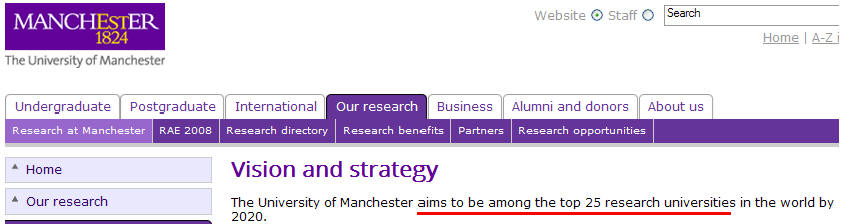
- A clue can be found in the ambitious Manchester University strategic vision published at
http://www.manchester.ac.uk/research/about/vision/
"The University of Manchester aims to be among the top 25 research universities in the world by 2020."
Here is the vision, as stated on their web site.
****************************
We comment: Cheating to a achieve a position in the top 25 league is wrong
Fabrication of research evidence is a criminal offence under the The Good Laboratory Practice Regulations 1999.
People who breach the regulations can be jailed. http://www.bbc.co.uk/news/uk-scotland-edinburgh-east-fife-22186220
We call for an open, externally led enquiry into what has been going on at Manchester University so that lessons can be learned.
For the last 350 years Britain has been a world leader in science. We cannot allow a tiny number of vain academics in our generation to destroy our heritage.
SUMMARY ENDS
Notes for busy readers
(i) For an overview of how the British establishment has buried the Manchester University fraud visit, our "British way of rewarding inventors" page.
(ii) This article below contains a lot of very detailed evidence of research and financial fraud at Manchester University.
For a shorter, third party summary of the fraud please visit www.abettermousetrap.co.uk/whistleblower-inventor-alleges-fraud-by-manchester-university
(iii) If you are carrying out research into scientific fraud, you may prefer to read the peer reviewed account of this case that has been published in The Journal of Biological Physics and Biology.
Now, here is the case in detail.
How Britain almost made the world's roads safer
Motor vehicles have become far safer for occupants over the last century.
Unfortunately, reductions in pedestrian casualties have not kept pace. In some respects the problem is getting worse.
The combination of increasing numbers of quiet electric cars and the addiction to pedestrian texting is creating a new pedestrian hazard on our roads.
But this problem could have been tackled before it became serious.
In the 1990’s, the European Commission tried to improve pedestrian safelty by drafting legislation that would require all new cars to be fitted with soft, pedestrian friendly bumpers.
Vehicle manufacturers were unhappy with this proposal, because soft bumpers would be less effective in low speed impacts with other vehicles and street furniture. And this in turn would cause insurance premiums to rise.
Show photograph of injury inflicted by a car bumper
Creating a car bumper that would keep insurance costs down and protect pedestrians is not beyond human ingenuity. In fact Bill Courtney had invented the answer way back in 1986, but it had no commercial importance at the time.
By 1997 Bill recognised that the time for his SALi filled bumper had come because it met pending EU requirements for pedestrian friendly car bumpers while also keeping the car makers happy. That is, it could be a “smart bumper”; soft for pedestrian leg impacts, but stiff for other impacts.
His early research findings were described in several research journals and magazines during the following three years.
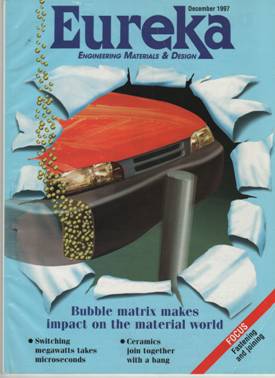
Figure 1. In 1997, an article was published in the engineering magazine Eureka. This gave the first public hint that a “smart” bumper was feasible. (Unfortunately it upset Bill's research supervisor, even though he tried to pacify him by changing the SALi brand name to "Manchester Material.")
Here is a short extract from the article:
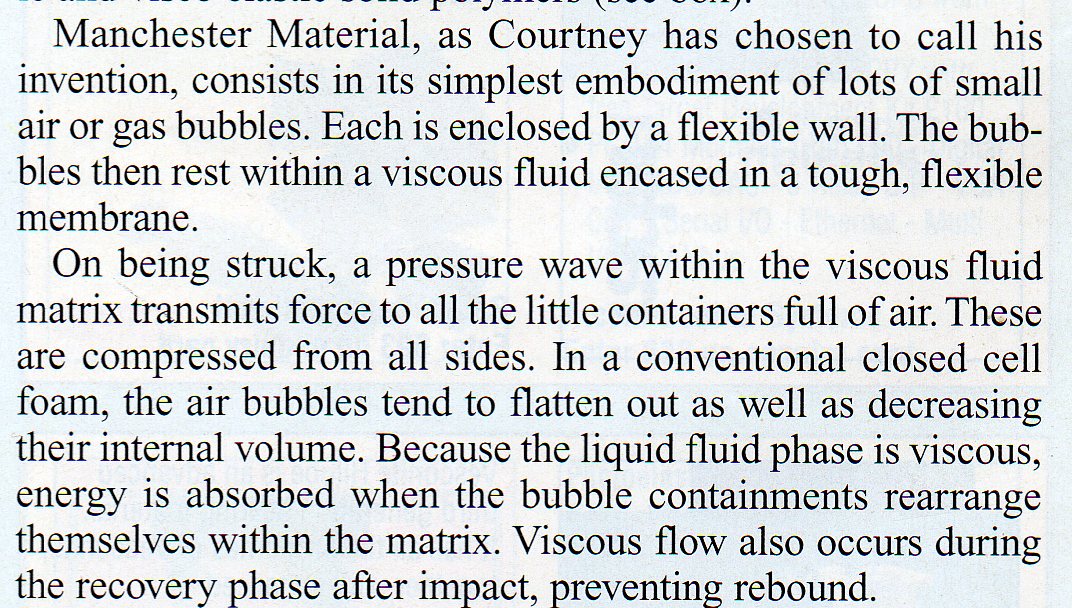
Eureka, Engineering Materials and Design, December 997, pages 24-25.
It is important to note the use of the term “tough, flexible membrane” in this extract.
Six years later mischievous researchers at Manchester University would publish deceitful research using a weak elastic packaging membrane. They would then use their fraudulent test results to claim that Courtney’s invention was ineffective. ~ All Courtney’s years of work were destroyed in a single lie. But the real victims are probably the poor unfortunate pedestrians who continue to be hit by stiff car bumpers.
As you will see from the evidence, many more lies were told during the following years, but their primary purpose was to hide the blatant falsehood of the very first lie.
Manchester University has continued to bluff away the fraud until the present day. Most recently, it has wriggled out of a request from the research funding body (EPSRC) to investigate the fraud.
How the PedSALi project started
In 1999, an article in Auto Express magazine attracted the attention of the Automotive Division of Dow Chemicals.
In March 2000, the PedSALi consortium consisting of Dow Chemicals, Bill Courtney (under his trading name of Cheshire Innovation) and the University of Manchester won £250,000 of UK government funding to build and test a prototype bumper according to Bill’s designs.
How it works: a soft bumper for pedestrians
(If you have come straight to this web page a more basic discussion of SALi Technology is available on our "What is SALi Technology? page.)
The following sketch represents a horizontal cross section through a SALi filled car bumper during a lower leg impact.
You are looking down on the bumper.
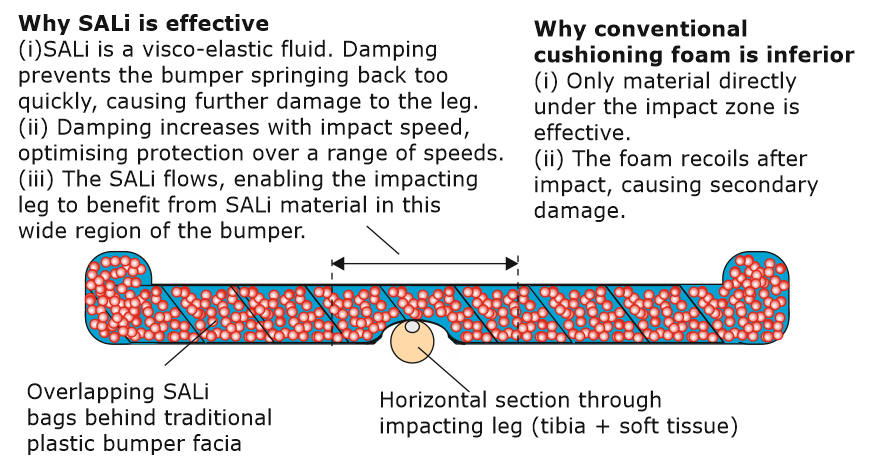
Figure 2. The bumper is soft for pedestrian impact.
The visco-elastic SALi fluid flows to the sides of the impact zone. This reduces the stresses on the leg by allowing it to travel the full front to back distance of the bumper before coming to a halt.
The viscous nature of SALi permanently absorbs some of the impact energy and slightly increases the bumper recovery time compared with a conventional foam filling. This reduces the secondary injuries caused by the pedestrian bouncing off the bumper.
Additional smart feature: A child’s leg has a smaller horizontal cross section than an adult leg, allowing the bumper to appear softer in accidents involving children.
Supporting research evidence (1997)
By increasing the width of a SALi cushion it softens. In contrast, changing the width of a block of bumper infill foam does not change its properties. The graphs below show maximum accelerations during impact; maximum forces on the simulated leg increase proportionately.
This graph is extracted from [3].
The foam material tested was supplied by the UK Motor Industry Research Association (MIRA)
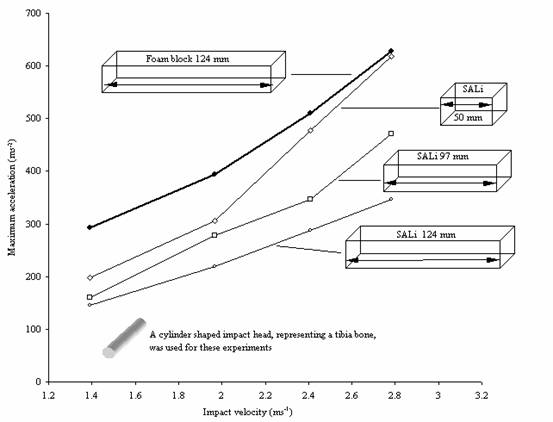
Figure 18. Impact energy absorbing performance of a block of expanded polypropylene foam, compared with SALi pads constructed using grease + granules of the same foam. The length of the block of foam did not affect the impact performance, provided that the length exceeded the diameter of the impact head, so the results for one length only are shown. In contrast, the maximum acceleration for the SALi pad declines as the length of the pad increases.
Now we will explain how the same SALi filled bumper stiffens up for impacts with concrete pillars and other hard objects
Again, this is a plan view looking down on a cross section through the bumper during an impact.
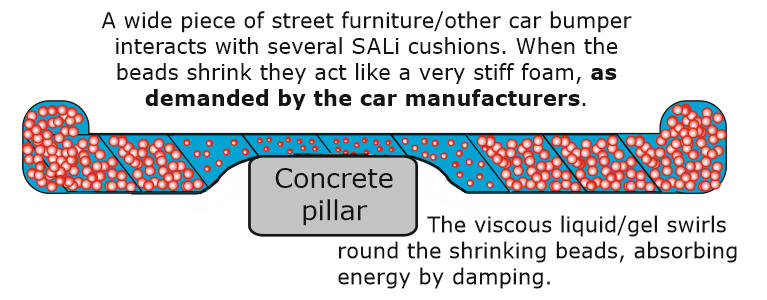
Figure 3, non-pedestrian impact. The SALi cushions compressed by the concrete pillar act like a very stiff foam. [See Section 7 on our car suspension page for a detailed explanation of why SALi beads offer exceptional stiffness as they are compressed.]
Consequently the bumper is stiff for non-pedestrian impacts.
Bonus smart feature: Viscous damping increases with compression rate, so the bumper stiffness and energy absorbing capacity increases with impact speed. The faster the car is travelling, the greater the impact protection.
SALi filled bumpers offered car manufacturers two new selling points.
(i) Unlike conventional bumpers, a SALi filled bumper would recover after low speed crashes, helping to keep insurance costs down. (Foam bumpers can spring back rapidly for leg impacts, but are damaged by impacts with more massive objects.)
(ii) A SALi filled bumper would be stiffer and offer extra occupant/bodywork protection to vehicles in medium speed crashes.
The PedSALi smart bumper would have added about 1% of the weight of a NissanLeef electric car battery to the weight of a car.
Supporting evidence 1997 [3]
The simulated leg impact tests are copied from above and the results for a simulated bumper-bumper impact added. These results show that SALi filled bumpers are “smart”. That is, they can be soft or stiff, depending on the type of impact
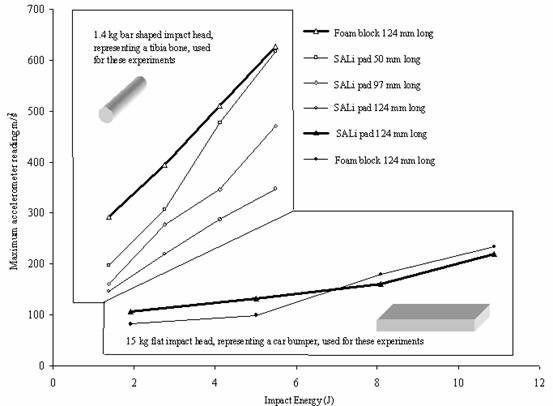
Figure 19. Simulated lower leg (1.4 kg mass) & bumper-to-bumper (15 kg mass) impacts
The broad conclusion suggested by the simulated bumper impact data, shown in Figure 19, is that a front bumper filled with a suitable formulation of SALi would behave like a soft foam filled bumper, for lower leg impacts, but like a stiff foam bumper, for bumper-to-bumper impacts. This difference in uniaxial stiffness behaviour, for different types of impact, could also be useful in solving the other conflict of stiffness problems identified by Clemo [3] and summarised in the introduction.
It is important to note that Courtney’s early experiments demonstrated that car bumpers would only exhibit soft/stiff “smart” behaviour if the car bumper outer face deformed but did not stretch significantly during impact.
So, how come most people don’t know about soft bumpers?
The university research was mismanaged and the EU legislation was abandoned.
The mismanagement
(i) Bill Courtney's research supervisor threw a bag full of spanners into the SALi research programmes. For details see Section 6 of our "What is SALi?" web page.
(ii) There was an eighteen month gap between the PedSALi project being approved and the University research starting.
(iii) No usable research results were ever delivered to the industrial partner for the project, Dow Chemicals Automotive Division.
Following a progress review in June 2004 a decision was made to wind up the PedSALi project.
Thirty three months after the delayed start of the University research, Dow had still not received any data for use in its computer modeling of different types of bumper impacts..
Consequently Dow had no evidence to encourage the rest of the automobile industry. Time had passed and its “window for commercial opportunity” had closed.
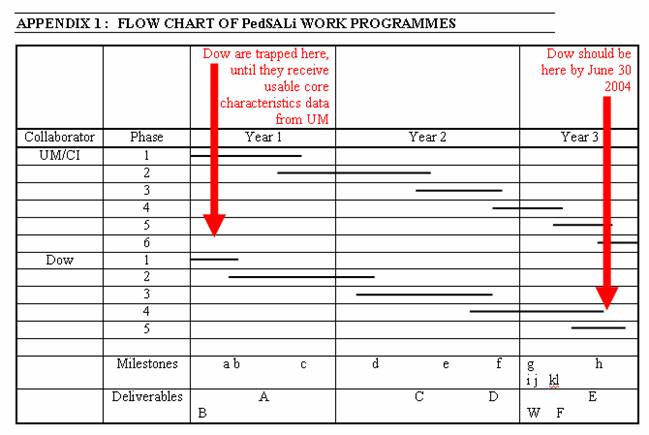
Here is an extract from the end of project review. The chart shows the original work plan as submitted to the funding bodies. The comments in red show what actually happened.
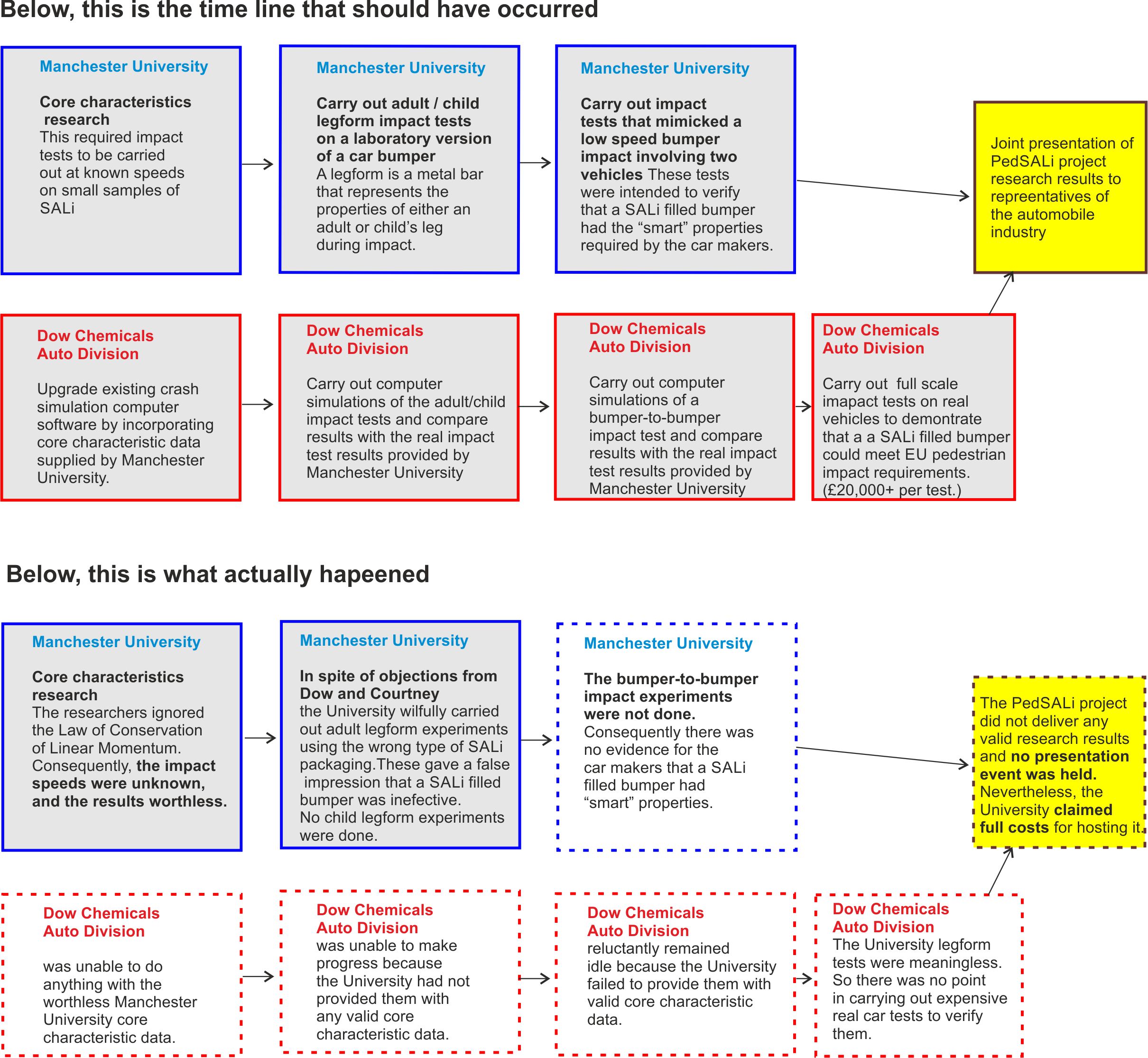
The University was offered public funding to carry out two types of experiment:
(i) SALi core characteristic work. The aim of this research was to obtain data about the impact energy absorbing properties of different SALi formulations.
Dow would use this data to carry out computer simulations of pedestrian leg and bumper-to-bumper impacts on a SALi filled bumpers.
(ii) Impact tests on a basic design of SALi filled car bumper to check that Dow's computer simulations were giving the correct answers. An important feature of these tests was that the packaging for the SALi had to mimic the low stretch properties of the outer plastic cover that can be seen on any car bumper.
As for Courtney's small scale 1997 research described above; In order to demonstrate the "smart" features of PedSALi bumpers, two types of impact tests were required: (a) to simulate pedestrian lower leg impacts, and (b) to simulate bumper-to-bumper/ street furniture impacts.
But the following is what happened in reality:
(i) The core characteristic research was so badly done that Dow was unable to use it. The work was an embarrassing nonsense that violated basic physics laws that GCE A level physics students would understand. This is why Dow was trapped at the beginning of its contribution to the project.
For more information about how the University researchers failure to grasp GCE A level physics click here.
(ii) Under protest from Dow and the SALi inventor Courtney, the University researchers willfully carried out invalid bumper simulation tests using elastic packaging. These tests did not reflect the true properties of a car bumper during a pedestrian accident and gave the research funding body a false impression that SALi filled bumpers were ineffective.
This false evidence of design failure created a smokescreen hiding the embarrassingly bad core characteristic research that had prevented Dow from making progress.
(iii) The University researchers failed to carry out the bumper-to-bumper/ street furniture impact tests. This meant that the EU policy makers and the car manufacturers were deceived by the published PedSALi research [12, 13] because the unique feature of the PedSALi bumper, that it could solve the “conflict of stiffness” problem by being soft for pedestrian impacts but stiff for non-pedestrian impacts was never revealed.
[This "smart" feature demonstrated by Courtney's earlier work was the key to the PedSALi project receiving Engineering and Physical Science Research Council support. But even though the University researchers deceived the EU policy makers and car manufacturers by publishing fraudulent work and failing to do the bumper-to-bumper impact tests, the EPSRC paid for the work and the person in charge of the University research was promoted.]
Summary
How hiding bad research cost Britain the chance to lead the world in road safety
In the first half of the PedSALi project, embarrassingly bad research that ignored the laws of physics was done.
In the second half of the project, tests using the wrong type of car bumper shell (i.e., SALi packaging) were deliberately done. This diverted attention from the embarrassing earlier research by creating false evidence that the PedSALi bumper design was ineffective.
The University researchers hid evidence that a British invention could have met both the humanitarian need for a soft bumper for pedestrian impacts and a stiff bumper for other types of collisions by the simple expedient of not doing the agreed comparative tests.
At the start of the PedSALi project, four objectives were clearly spelled out in a collaboration agreement between Dow, Cheshire Innovation and Manchester University. None of these objectives were achieved and harm was done to the UK as an innovative nation. In spite of this, the University was paid from the public purse for its work.
Why did the EU abandon its legislation?
Apart from SALi, there was no technology available to solve the “conflict of stiffness” problem
Two months before the delayed start to the University research, the car makers began lobbying the European Commission, claiming that solving the problem was impossible.
The lobbying was successful because the PedSALi partners had no substantive evidence to show the Commission. The Directive was withdrawn in February 2003.
Would the smart bumper have worked?
The Manchester University researchers claimed in their project report to the Engineering and Physical Science Research Council (EPSRC) that SALi filled bumpers were ineffective.
This claim was backed up by research papers that they had presented at American conferences in Virginia Beach and San Diego, California.
[11, 12, 13.]
BUT
(i) The published research was invalid and carried out under protest from Dow and the inventor, Bill Courtney.
(ii) The false research was published in breach of a confidentiality agreement signed with Dow and Courtney.
(iii) News of the misleading publications and the trips to America only reached Bill after a confidential tip off from within the University.
Why was the published research invalid?
There were many flaws in the published papers. Here are a few of them:
(i) The research was limited to cylinder shaped “bumpers” which nobody in the automobile industry uses.
(ii) Early tests by Courtney had shown that cylinders were less effective than “D” shaped bumpers when filled with SALi. But this evidence was ignored by the Manchester researchers. [Take a look at the titles of their fraudulent papers 12 and 13 below. - They both refer to cylinder shaped devices.]
(iii) the impact tests were done using elastic packaging. [12, 13.]
Elastic packing prevents the SALi from doing its job. Instead of the SALi being compressed and absorbing a significant amount of impact energy, the package expands and absorbs a small amount of energy. The innocent reader of the research papers is tricked into thinking that SALi is ineffective.
(iv) The impact tests did not include the vitally important bumper-to-bumper impact simulations that would have verified SALi's unique "smart" properties.
(v) The nonsense research paper referred to above falsely misquoted Courtney's own published research, claiming that SALi filled bumpers were unable to make a good recovery after an impact.
Comment
British based researchers should not be going to America to trick their international colleagues in this way. British taxpayers should not be subsidising these trips and research trickery.
"Researchers lie and pedestrians die"
The hidden good research
The first PedSALi research assistant resigned after his research materials mysteriously disappeared from the Manchester engineering labs and there were ten unexplained attacks on his temporary family home close to the University.
(Bill was concerned that the research assistant was being intimidated. He requested that the police were called in. But Dr. Oyadiji and Professor Wright, the University recipients for the PedSALi research funding overruled him.)
A week before leaving, the long suffering research assistant produced valid research results using low stretch “D” shaped packaging. This good research, which showed a fivefold improvement in performance compared with the elastic packaging results, was withheld from publication. Consequently the EPSRC and the automobile industry were misled.
The good and bad research results are compared in Appendix 2 below.
Unfortunately the researcher was unable to test the lighter, more efficient SALi formulations described in Section 3 of the "What is SALi?" page because his irritated line manager, Doctor Oyadiji, banned him from using the laboratory after two days of good work.
The good experiments were repeated at Cardiff University six years later. The original good results were confirmed and published. [4]. The Cardiff experiments were only small scale but they did include research similar to the banned Manchester work. To lighten their SALi formulations the Cardiff workers had to use soft Expancel microspheres. These are not as efficient as the calcium carbonate coated Dualite microspheres that were available and should have been tested at Manchester.
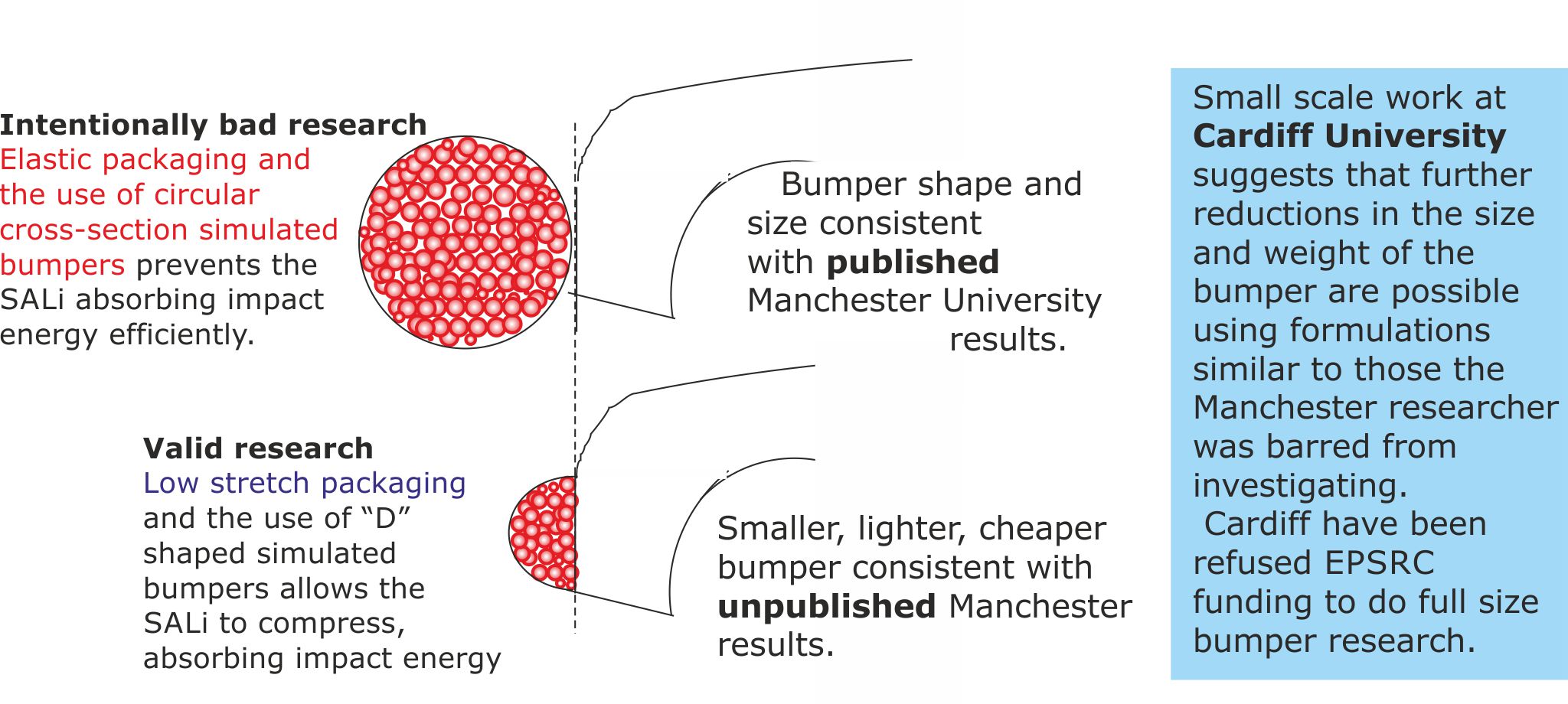
Figure 4 The selective publication of misleading results suggested that a SALi filled car bumper would be unacceptable to the automobile industry. This fraudulent research "Proving" that the bumpers do not work “absolved” the academic researchers of any responsibility for the failure of the PedSALi project.
In total, four misleading papers [11, 12, 13 and 14] were published in breach of the confidentiality clauses of the PedSALi collaboration agreement. Please see point 2 of “Checking our claims”, below, for advice on gaining access to these papers.
Here is a timeline showing how the PedSALi project let down Europe's pedestrians
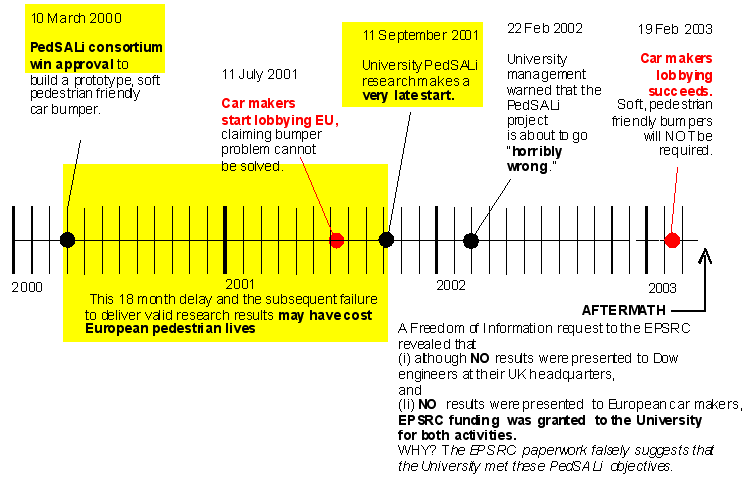
Figure 5. The PedSALi project failed to deliver, but Manchester University received full funding.
(i) This project failure could have been avoided if an early warning to the Head of Engineering at Manchester University that the project was about to go "horribly wrong“ had been acted on. Click here to see the warning.
(ii) Click to see an annotated page from the deceitful paperwork that the University sent to the EPSRC.
Fighting the fraud
Bill Courtney was appointed lead partner for the PedSALi project by the Department for Transport. He suspected financial fraud had been committed and that the EPSRC had been deceived. He requested copies of the relevant documents from the University.
But the University withheld financial information from the lead partner
Some months later he obtained the financial documents indirectly from the EPSRC.
- What was the most blatant financial fraud?
A. The University claimed funding for a fictional event where the results of the PedSALi project were supposedly presented to the automobile industry. They also claimed funding for trips to Dow Chemicals UK headquarters, to present research results to Dow engineers. These visits were never made.
For the record Bill Courtney was also offered public funding to cooperate in these activities. Collusion with his University colleagues would have allowed him to pocket £10,000. He did not claim.
(You can use the Freedom of Information Act to verify Bill's honesty. We explain how to do this below.)
Bill complained to the University after discovering the financial fraud. His evidence of fraud was dismissed by the University on the grounds that the research was acceptable to the EPSRC, so any discrepancies in the funding claims were also acceptable under EPSRC rules.
(See Appendix Three for a detailed discussion.)
The wider consequences of management level collusion with research and financial fraud
(i) A publicly recorded failure affecting Manchester's research rankings was avoided.
(ii) Any suspicion that Manchester University researchers cannot be trusted was avoided.
Bill Courtney acknowledges that this is a genuine problem because the misconduct is restricted to one small research group and it would have taken great moral courage to confront it.
(iii) This failure of moral courage gained increasing importance after two brilliant Manchester University researchers were quite rightly tipped to win the Nobel Prize for Physics, for their honest and highly original work on graphene.
But the Manchester University cover-up cannot be condoned because crippling and mortal injuries continue to blight pedestrian lives.
9/11, A dark day in history
It’s a bitter irony, but the delayed University research started on the same day as the 9/11 attacks on America.
History may record that in the long run, the University mismanagement of the PedSALi project caused more pointless deaths than all of the terrorist attacks on America, Madrid, Mumbai, Bali, London, Nairobi, Norway, Paris and Tunisia.
Data to support this claim
According to the Department for Transport, 5,605 pedestrians were killed or seriously injured in 2010, on the UK roads alone. If we consider the death toll for all of Europe's roads since 2005 when pedestrian friendly cars should have been introduced, the total numbers are frightening.
If smart car bumpers had been introduced in 2005, then the financial savings for the Eurozone countries alone would probably have been sufficient to pay for the third Greek bailout.
Historians may also be tempted to draw comparisons between the PedSALi fiasco and “the worst industrial accident in history." This happened at Bhopal in India, in 1984. At the very least, 4,000 people died as a result of a chemical plant gas leak. This site is now owned by Dow Chemicals. (But in the PedSALi case, Dow was a victim, not a perpetrator. )
But the Bhopal victims did not die completely in vain because lessons were learned and the risk of similar industrial accidents reduced thereafter. In contrast, Manchester University aided by the UKRIO has hidden the research mischief and no lessons have been learned.
We cannot have one standard of ethics for industry, and another for academia.
Please check our claims
1 The University held a Formal Enquiry that was supposed to reveal the truth. Instead it added a second layer of fraud that buried it deeper. Bill responded by trying to shame members of Institute for Science, Ethics and Innovation into speaking up for truth within the University. He did this by sending all listed members a testimony and inviting them to respond.
The tactic failed, but the testimony contains evidence that you or any member of the Institute can check online. So, if you are serious about investigating research fraud, it's worth reading.
Use the Freedom of Information Act to obtain a copy from the University. [The Records Management Office, Risk and Compliance, The University of Manchester, G 011, John Owens Building, M13 9PL, Email: This email address is being protected from spambots. You need JavaScript enabled to view it. ].
However, be warned, tactics may be used to foil your request. Please click to see evidence of the tactics previously used by the University..
2 Nullius in verba "Trust no one"
In order to gain a balanced picture, consider asking the University of Manchester for their version of events, including details of the unpublished PedSALi research and the June 2004 review quoted above.
3 In contrast to PedSALi, workers at Cardiff University, operating on a shoestring budget have produced impressive results.
[Huw Davies et. al., Cardiff University School of Engineering, Pedestrian Protection using a Shock Absorbing Liquid (SALi) based Bumper System, ESV Conference, Stuttgart, June 2009, Paper Number 09-002.]
What is the current position?
On the assumption that the Formal Enquiry Panel would deliver an honest report, Cardiff University applied for EPSRC research funding to do the PedSALi research correctly. Unfortunately, the enquiry process was not honest and the original fraudulent Manchester research was allowed to stand. This undermined the Cardiff case for funding and its EPSRC funding request was declined.
Research paper references
These references are a sub-set of those on our What is Shock Absorbing Liquid (SALi) Technology? web page.
There are gaps in the numbering because the same reference numbers are used.
1 Courtney, W. A. Preliminary investigations into the mechanical properties and potential applications of a novel shock absorbing liquid, MPhil Thesis, Manchester School of Engineering, University of Manchester (1998)1
3 Courtney W A and Oyadiji S O (2000). Characteristics and potential applications of a novel shock absorbing elastomeric composite for enhanced crashworthiness. International Journal of Crashworthiness 5:4 (2000) 469-490.
4 Huw Davies et. al., Cardiff University School of Engineering, Pedestrian Protection using a Shock Absorbing Liquid (SALi) based Bumper System, ESV Conference, Stuttgart, June 2009, Paper Number 09-002.
5 H. d. Teng, Q. Chen, Study on vibration isolation properties of solid and liquid mixture, Journal of Sound and Vibration, (2009) doi.10.1016/j.jsv.2009.04.036
11 S O. Oyadiji et. al., University of Manchester, Core property characterization for a shock absorbing composite, SAVIAC 75th Symposium, 17-22 October 2004. False research published in breach of agreement and under protest from Courtney.
12 S O. Oyadiji et. al., University of Manchester, Characteristics of deformable cylindrical beams filled with a shock absorbing composite, SAVIAC 75th Symposium, 17-22 October 2004. False research published in breach of agreement and under protest from Courtney.
13 G. Georgiades et. al., Impact response of flexible cylindrical tubes filled with a shock absorbing composite, University of Manchester, SPIE Conference 7-10 March 2005. False research published in breach of agreement and under protest from Courtney.
14 G. Georgiades et. al., University of Manchester, Characterization of the Core Properties of a Shock Absorbing Composite, Journal of Engineering Materials and Technology, ASME, October 2007, Vol. 129, pages 497-504. False research published in breach of agreement and under protest from Courtney.
18 W. A. Courtney and S. O. Oyadiji, University of Manchester, A Novel shock absorbing solid-liquid Composite with potential for automobile engineering applications, 1: Basic concepts and properties of SALi, Journal of Automotive Engineering. Courtney handed this paper to Oyadiji for final checking in July 2000, but it was not taken forward to publication.
19 W. A. Courtney and S. O. Oyadiji, University of Manchester, A Novel shock absorbing solid-liquid Composite with potential for automobile engineering applications, 2: Variable stiffness car bumpers, Journal of Automotive Engineering. Courtney handed this paper to Oyadiji for final checking in January 2002, but it was not taken forward to publication.
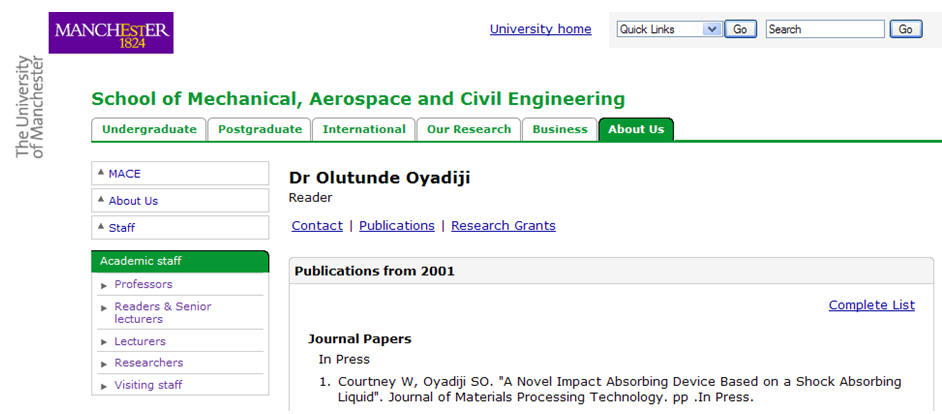
20 Courtney W, Oyadiji S O. A Novel Impact Absorbing Device Based on a Shock Absorbing Liquid. Journal of Materials Processing Technology. This is a ghost paper.
Courtney handed the paper to Oyadiji for final checking and submission, 8th April 2002. According to the Manchester University web site (2007) The paper was “In press.” But when Courtney checked with the publisher, Elsevier, they could find no evidence of this paper being submitted.
Ghost paper: The proof
Extract from Manchester University web site, 15 March 2007.
Courtney comments
The ghost paper was a threat to the fraudulent SALi research published by Oyadiji et. al., because it emphasised the importance of correct, low stretch packaging. The ghost paper is not referred to in the Formal Enquiry Report.
Two other suppressed papers, references 18 and 19 above were also a threat to the fraudulent SALi research. In 2002 Courtney complained about their suppression to the head of the Mechanical Engineering Department. He requested a meeting to discuss this matter and other issues that threatened the success of the PedSALi project. But his request was ignored.
As listed in Section 6 of the "What is SALi?" page, further complaints about the suppression of these papers were made to senior University management at later dates. Inn 2009 the Formal Enquiry Panel had access to all these documents. But this suppression of papers is not referred to in their Report.
Suppression of papers 18 and 19 may have cost lives because their publication would have neutralized arguments from the car manufacturers that the conflict of stiffness problem could not be solved.
- What should Manchester University have done?
- Instead of denying the research fraud and then burying it under successive layers of management fraud, it should have acted in the moral manner of Tilburg University in the Netherlands and practiced complete openness.
https://www.commissielevelt.nl/
The outcome was was embarrassing for Tilburg University, but protected the wider reputation of Dutch science.
Manchester should follow the good Tilburg example.
We end this section on a more optimistic note for the future
Smart, pedestrian friendly car bumpers could reduce injuries in new types of accident
(i) Pedestrians and drivers who are viewing their mobile devices instead of watching the road are an increasing cause of pedestrian accidents.
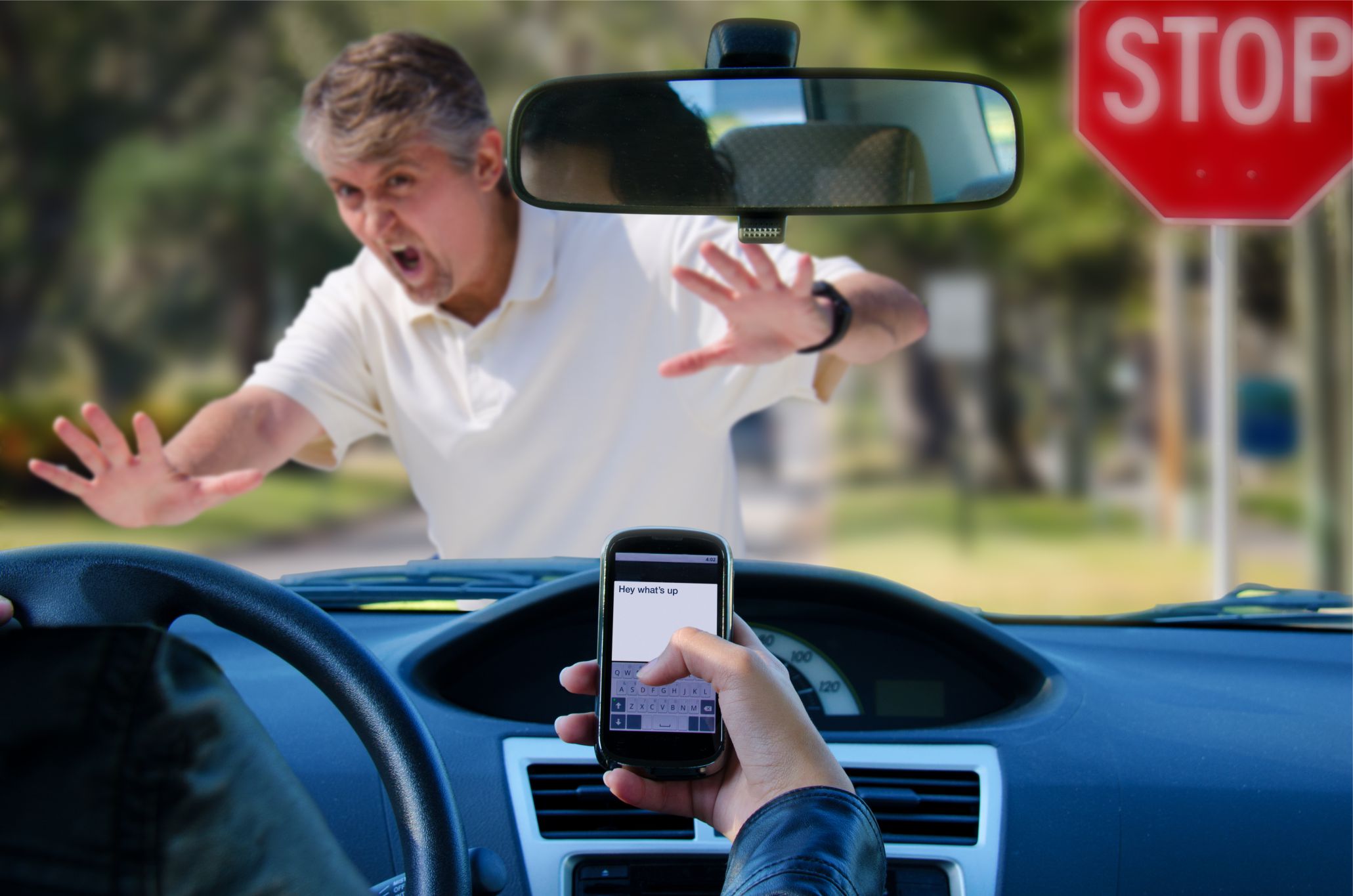
(ii) Driverless cars
We quote an online article, “Pedestrian Test Dummies Put Driverless Cars to the Test".
Consumers have mixed opinions about driverless cars. Some are excited for the changes they’re supposed to bring, including the elimination of reckless driving and the benefit of convenience. Others are concerned that they will cause more accidents than they stop. The biggest controversy has been the risk of driverless cars hitting pedestrians.
Provided the fraudulent PedSALi research results and claims of poor performance are retracted and the smart bumper research is done correctly, SALi Technology could reduce 'smartphone accidents' and make driverless cars safer.
Bill Courtney would be happy to work with a collaboration including Manchester University engineers, proved they are not tainted by the PedSALi fraud.
Manchester would be an excellent location for this work because a combination of graphene based SALi packaging and a graphene based outer bumper facia would offer the ideal combination of high strength and low weight. As a bonus, the superb thermal conduction properties of graphene would allow the front bumper to replace the conventional car radiator in vehicles powered by an internal combustion engine.
Appendix 1
Proof that the bumpers required low stretch SALi packaging
1.1 The research proof
Courtney objected to the publication of papers [12] and [13] above because they described impacts on elastic packages filled with SALi.
His own research described in his M Phil thesis [1] and the suppressed papers [18] and [20] had demonstrated that elastic packages were ineffective and could not solve the conflict of stiffness problem.
1.2 The contractual agreement proof
The UK Department for Transport description of the PedSALi project appears at http://www.dft.gov.uk/rmd/project.asp?intProjectID=10434
A bitmapped copy of this page is reproduced below.
The key section relating to the importance of low stretch packaging has been highlighted.
-----------------------------------------------------------------------

Home > Science and Research > RD > Programmes > DfT - Vehicle Standards and Engineering > (G) Foresight Vehicle > PEDestrian protection using Shock Absorbing LIquid technology (PEDSALI)
DfT Research Database
Project: PEDestrian protection using Shock Absorbing LIquid technology (PEDSALI)
Reference: C3/P35
Last update: 13/10/2003 09:58:29
Objectives
At the end of the project it is anticipated that, using Finite Element techniques, it will be possible to predict the performance characteristics of a SALi based shock-absorbing component. Physical testing be will used to confirm the predicted results and validate the model. The chosen materials will be assessed using FMEA techniques to ensure that any adverse effects, such as toxicity and corrosive properties, are recognised and evaluated.
Description
This highly innovative project is researching a new composite, impact energy absorbing material that can in effect, automatically alter its stiffness, to cope with different types of impact. At present it is being evaluated with respect to the reduction of serious and fatal pedestrian casualties as the result of road accidents, in line with DTLR targets.
The patented material being investigated is a Shock Absorbing Liquid (SALi) which consists of lots of small resilient elastomeric capsules immersed in a matrix liquid and stored in a strong flexible package. Upon impact, all of the capsules are compressed by the matrix liquid and the front face of the package deforms to the shape of the applied load. The compressive stiffness of SALi filled packages increases as the area of applied load is increased. Consequently, a suitable sized package would be soft for a small child’s head impact, but stiff for an adult head impact. If SALi filled packages are integrated into car bumper systems, then the bumpers will be soft for lower leg impacts, but stiff for low speed bumper-to-bumper impacts. This will help to make vehicles safer for pedestrian accidents, while keeping vehicle repair costs low.
The unusual cushioning properties of SALi can be illustrated by comparing its impact absorbing performance with that of a block of elastomeric closed cell foam.
The project is investigating the three parameters that influence the physical characteristics of a SALi filled impact absorber: the matrix liquid, the size and nature of the elastomeric capsules and packaging design.
The matrix liquid acts as a lubricant to facilitate the movement of the capsules and to transmit the hydraulic pressure changes when a load is applied. Additionally the liquid provides viscous damping when the steady state condition is disturbed due to its shear viscosity and bulk viscosity properties.
The capsules can vary from expanded polystyrene beads to bubble packing. The size distribution of the capsules need to be optimised in order minimise the total weight of the impact absorber, without compromising on impact absorbing performance.
The packaging provides a flexible leak-proof envelope to contain the liquid and capsules but, importantly, it must not stretch significantly during load application. Also, the package must not burst open and eject its contents during a violent impact. The size and shape of the package will affect impact energy absorbing performance.
Contractor(s)
University of Manchester
Oxford Road, Manchester, M13 9PL
Cheshire Innovation
17 Vale Road, Timperley, Altrincham, Cheshire, WA15 7TQ
0161 980 5191
Contract details
Cost to the Department: £44,200.00
Actual start date: 01 March 2001
Expected completion date: 30 September 2004
Note for the web page reader:
The Department for Transport (DfT) appointed Bill Courtney trading as Cheshire Innovation as the lead partner for the project. In this role he complained to the DfT and the Engineering and Physical Science Research Council (EPSRC) about fraudulent University research being done.
Click to see a sample warning letter
Click to see a sample follow-up letter
Appendix 2
The following comparison between the unpublished good research and the published bad research was sent to The Records Officer at the University of Manchester (7th March 2007). Duplicate copies were subsequently sent to The Research Integrity Office and The Institute for Science, Ethics and Innovation at the same University.
You can obtain a copy of the letter from the University, under the terms of the Freedom of Information Act. This letter includes references to the primary source, where the good research was written up for the PedSALi partners.
-------------------------------------------------------------------
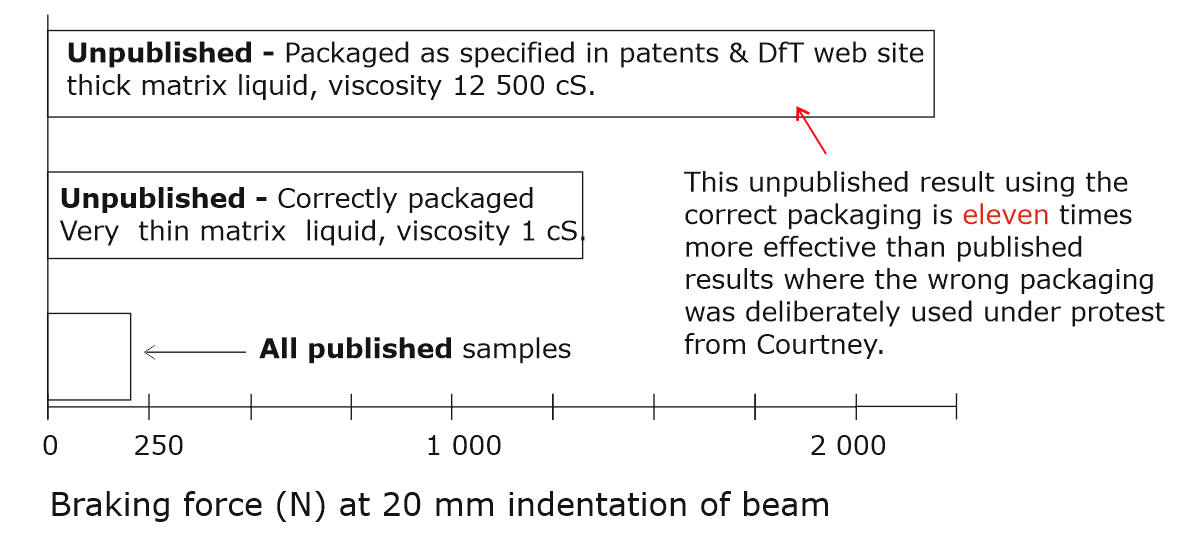
Figure 6. Originally Figure 4 in Exhibit 11.
Compact car bumpers require good energy absorption during the early stages of indentation. The published results falsely suggest that SALi only offers a small braking force and is ineffective during the early stages of impact.
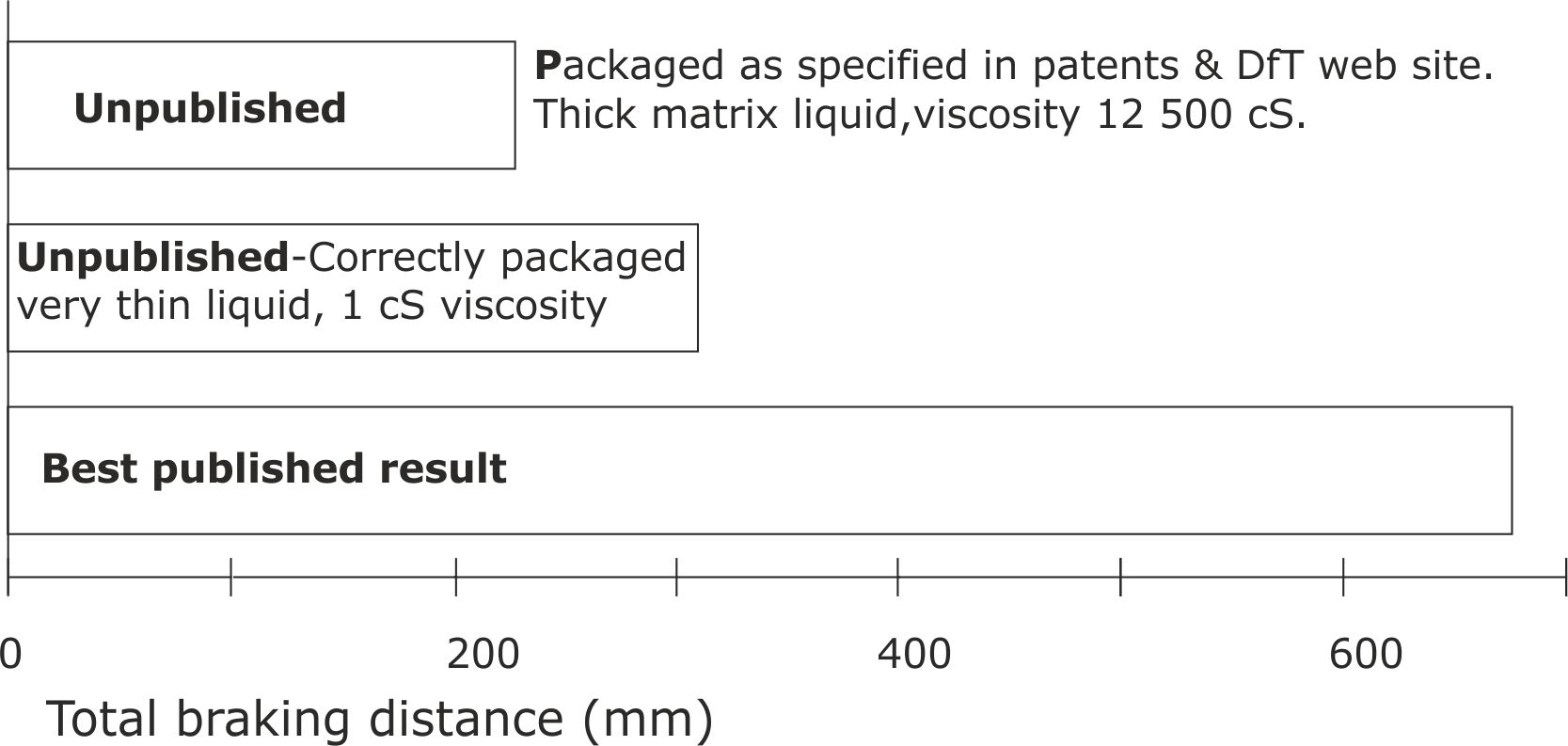
Figure 7. Originally Figure 5 in Exhibit 11 for the Formal Enquiry.
The published results give a false impression that a long braking distance is required. In practical terms this means that a ridiculously large bumper would be required. See Figure 4 above.
The published results are even more misleading because the good results were obtained using a smaller sample.
If results for similar sized samples had been compared, the magnitude of the deceit would have been even more obvious.
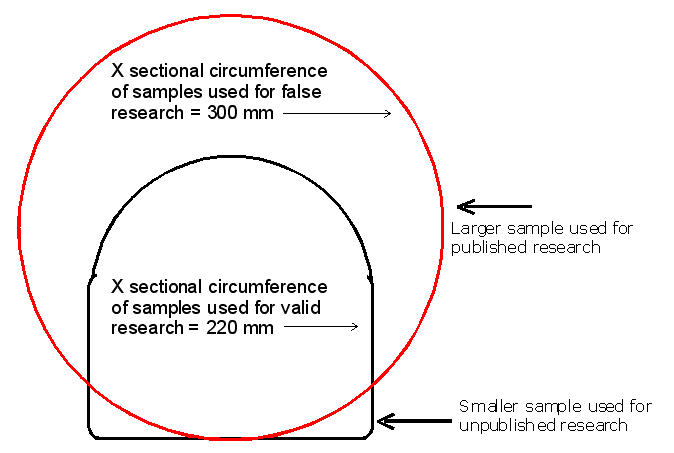
Originally Figure 6 in Exhibit 11 for the Formal Enquiry.
Figure 8. The first research assistant carried out tests on valid samples having a circumference of 220 mm. These results were not published.
The second research assistant carried out research using incorrectly packaged samples having a cross sectional circumference of 300 mm.
In spite of their smaller cross section, the correctly packaged devices still offer significantly better crash protection.
Extract from complaint letter to the University of Manchester ends
Want to know more?
Discussing the flawed SALi research papers in detail would massively increase the length of this web page.
To examine one of the papers in detail click here.
Questions and Answers
- Why did the EPSRC pay Manchester University for doing misleading research in spite of Bill Courtney's fraud warnings?
- Using the The Freedom of Information (FoI) Act the reasons become clear.
(i) A fictional Technical Review of the research results by Dow Chemicals in 2004 was created by the University for the EPSRC.
This misled the EPSRC into believing that a foam alternative to SALi was available and that having reviewed the University research, Dow concluded that by comparison, “SALi bumpers were too heavy, too expensive and too complex”.
In reality there was no valid research data for Dow to review and no such foam was available.
Proof of this deceit lies in the hospitals and mortuaries; pedestrians are still being crippled and killed by stiff bumpers.
(Document IC 12 presented to the Formal Enquiry Panel verifies that the EPSRC was deceived by the University.)
Dow played no part in this deceit and were unaware that the EPSRC had been fooled.
(ii) The EPSRC failed to pass Bill's fraud complaints on to their referees who assessed the University research for payment. (An admission of this failure by the EPSRC is presented in Section Four of this linked web page.)
(iii) This careless behaviour by the EPSRC might be explained by the additional University trickery used to deceive them.
The Department for Transport appointed Bill as lead partner for the PedSALi project, so his fraud warnings should have been taken seriously.
But he discovered that his name, contact details and key role was airbrushed out of the initial submission and financial claim documents submitted to the EPSRC. Click to view the evidence.
Bill's role was also airbrushed out of all the PedSALi research papers submitted to the referees because he was not named as being a participant in the project. [You can check this for yourself by reading references 11, 12, 13 and 14 listed above.]
(iv) The University breached its FoI Act obligations by failing to release the incriminating documents to Bill.
He eventually obtained them from the EPSRC. (Evidence that the University was aware that it had broken the law is presented in Figure 4, Document C1.)
- After discovering the evidence that the EPSRC had been deceived, what did Bill Courtney do about this?
- At about this time the University set up an Institute for Science, Ethics and Innovation, so Bill sent his evidence of fraud to the Institute. (Hard copy letter plus supporting documents on a CD ROM.)
This resulted in the University carrying out a Formal Enquiry. The EPSRC agreed to accept its findings
Q. What were the Formal Enquiry findings? - The Enquiry employed some neat tricks that allowed the Panel to dismiss all of Bill's fraud claims.
Dr. Oyadiji was selected as a scapegoat for investigation. Dr. Turner and Professor Wright who should also have been investigated were then allowed to present evidence as as "independent" witnesses.
This enabled them to testify on behalf of the scapegoat and against Courtney.
During the period of the Enquiry Bill made two written protests about the use of this scapegoat "trick", but his protests were ignored. (You can use the Freedom of Information Act to verify this.)
The Enquiry succeeded in further discrediting the reputation of SALi Technology by suggesting that SALi filled bumpers were a foolish invention that could not work.
For the innocent reader, this part of the Report seems to make sense. It records that Bill marketed SALi believing that it had a single Goldilocks stiffness that was just right for all types of pedestrian impacts and car crashes. The Report also implies that Bill considered this Goldilocks stiffness was just right for use in car suspension systems.
A single stiffness material that meets all these different engineering needs is physically impossible. But recording that Bill believed this nonsense makes him look incompetent by University and EPSRC engineering standards.
- How did the Panel support this nonsensical statement about Bill's "beliefs"?
- The Report claimed that the results of the PedSALi and CrashSALi projects were scrutinized by a "Technical Committee of 6 engineers, of more than 120 man-years of engineering experience" and that the Committee found the evidence did not back up Courtney's "beliefs".
But this was a GHOST COMMITTEE - it never existed
(i) One named member of the committee resigned from his Manchester University post in despair and returned home to China two years before the committee is supposed to have met. (His temporary Manchester home close to the University was attacked on ten occasions and his PedSALi research materials mysteriously disappeared, presumed stolen. But Dr. Oyadiji and Professor Wright refused Bill's request for the police to be called in.)
(ii) Another named member, supposedly representing Dow Chemicals, has made a written statement denying his membership. (Document IC 12 on the CD ROM, as sent to the Institute for Science, Ethics and Innovation)
(iii) Bill has not met anyone who has ever heard of this committee.
(iv) Multiple Freedom of Information requests have failed to produce any documents that refer to its existence. (You can check this for yourself by making an FoI request to the University.)
(v) Even if the Committee had existed, its findings would have been wrong because the research on the PedSALi and CrashSALi projects was invalid and carried out under protest from Courtney. (For evidence that the CrashSALi research was invalid see Figure 2 on the CrashSALi web page.)
We discuss this ghost committee again in Appendix 3.
Implications for British science
(i) Prior to the Formal Enquiry, PedSALi was a "local" ethics problem restricted to crash research.
But the Report presented a fictional expert peer review in order to hide research fraud.
This creates a wider ethics problem by undermining trust in the peer review process across the whole of science.
(ii) These are difficult financial times for Universities. If a University gains competitive advantage by violating peer review and the formal enquiry process it will be tempted to repeat the exercise.
- Could the Panel have made an innocent mistake?
- The Panel had no excuse for undermining Bill's good name by making false claims about him.
PedSALi had only won public funding because Bill's published research demonstrated that that SALi was a "smart" material that provided different levels of stiffness for different types of impact.
You can check the evidence presented to the Panel for yourself. [Figures 2, 3 and the supporting evidence above. Also, see the Department for Transport description of SALi filled bumpers in Appendix 1 above.]
- Was this the only "mistake"?
- The Formal Enquiry Report included a number of demonstrably false statements that damaged Bill's professional name. For example, it recorded false evidence that his dealings with the good UMIST researchers referred to in Appendix 4 below had been unethical because they breached his commercial confidentiality agreement with Manchester University.
(The honest Business Manager at Manchester University, Dr. M... C..... who advised Bill on his dealings with UMIST could have punctured this libel in a sentence. But, in spite of Bill's written recommendation to the University Vice Chancellor, she was not interviewed by the Enquiry Panel.)
The Report also falsified dates. The most serious falsifications allowed the Report to hide:
(i) The truth about the critical delays in the University research start date.
(ii) The truth about the trips to America and presentation of fake research results in breach of the commercial confidentiality agreement.
- How was all this misinformation hidden?
- The format of the Report lacked academic rigour. It had no accessible indexing, referencing or footnotes. Consequently comparing statements recorded as "facts" with the primary source evidence was very difficult.
- What did Bill do next?
- (i) The report was an assembly of false facts about Bill's professional reputation and his invention. So he complained to the Information Commission about the University holding such a record. But the Commission declined to intervene because it had limited funds and the issues were too complex.
(ii) Bill also tried to clear his name by sending evidence that the Panel's findings were corrupt to the Institute for Science, Ethics and Innovation. He is partially sighted, so the delays caused by writing to the Information Commission and then collating evidence for the Institute were a very time consuming tasks.
The University refused to consider Bill's evidence because it was not received within 10 (ten) days of the Report being sent. This is discriminatory because the Report itself was delivered a year later than recommended by University of Manchester guidelines. (Meanwhile Bill ran out of funds and had to abandon his international patents relating to SALi.)
Since then Bill's emails to anyone at the University "Ethics Institute" have bounced back as "undeliverable".
Q. Who polices the Universities when this type of situation arises? - At an early stage in the problems, Bill Courtney's MP Graham Brady sought an answer to this question. The then Science Minister, Lord Sainsbury, ruled that he was unable to intervene and that it was for Mr Courtney to resolve the problem himself. [The Sainsbury letter is reproduced as Appendix 6 below.]
There appears to be no mechanism for dealing with Universities that refuse to address research fraud.
So with great reluctance and after a game changing event, Bill has taken the only option left; publishing the evidence in detail on the web.
- What was the "game changer" that made Bill go public?
- His health deteriorated over the years of his dispute with Manchester University. In particular, his eyes started hemorrhaging and the process was irreversible. He was registered as partially sighted and had had difficulty crossing busy roads. He was knocked down by a car and the pedestrian safety issue became personal.
You are challenged to check the facts
The bulk of the evidence has now been published on this web site. If you have a professional interest in defending the integrity of science or the public purse, Bill Courtney will send you a CD ROM copy of all the residual evidence submitted to the Institute for Science, Ethics and Innovation.
You can then contact Manchester University and the EPSRC to cros check Bill's claims. The Freedom of Information Act is a very powerful tool that will enable you to do this.
If you do go to the trouble of carrying out a rigorous investigation, you should compare the quality of the evidence you receive from both sides.
1 THE WHISTLEBLOWER'S SIDE
Bill Courtney’s submissions to the Institute for Science, Ethics and Innovation / Formal Enquiry Panel were supported by very detailed references, with a total of about 110 (one hundred and ten) documents being supplied in all.
2 THE UNIVERSITY SIDE
In contrast, the Formal Enquiry Report findings have to be taken on blind trust.
The Report does not include primary copies of any of the evidence taken, any list of evidence, or other form of referencing. (Assuming that you receive the same Report as sent to Bill Courtney.)
YOUR DETECTIVE CHECKLIST
Omissions from the Report relating to research and financial fraud that you can check
(i) The PedSALi research was fraudulent because, by using elastic packaging, a false impression that SALi does not work work was created.
The Report provides no justification for this fraudulent work being done at public expense.
(ii) The Enquiry Panel was presented with evidence that the University researchers had created a libelous document implying that the false research was only done because Dow Chemicals had demanded it. [Document 37.] The University sent document 37 to the Engineering and Physical Science Research Council and also the Department for Transport.
The Formal Enquiry Report makes no reference to document 37.
(iii) As explained at the beginning of this article, the PedSALi bumper offered a unique solution to the conflict of stiffness problem. It was a "smart" bumper, being soft for pedestrian impacts and stiff for other potentially expensive bodywork damaging impacts. But the comparative PedSALi impact tests that should have verified this property were never done. Consequently the car makers argument that the conflict of stiffness problem could not be resolved remained in force. There is no reference to this key research omission in the Formal Enquiry Report.
(iv) Two trips were made to America, to present the fraudulent research to the international research community. [Papers 11 and 12 at Virginia Beach, USA and paper 13 in San Diego, California.]
Bill Courtney only discovered this after a confidential tip-off from inside the University.
The Report offers no explanation for British taxpayer funds being used to fund these foreign trips.
(v) The CrashSALi researchers used ineffective materials that breached the publicly funded contract. Consequently, Bill Courtney, who held stewardship over the funds wrote to the (then) University Vice Chancellor insisting on the work being done correctly.
The University responded by using its solicitors Eversheds to intimidate Courtney into approving payment without the contract being fulfilled. This intimidation had a serious effect on Bill's health. (He was treated for depression, his blood pressure shot up and blood vessels in both of his eyes hemorrhaged.)
The Report offers no explanation for this bullying.
(You can see medical evidence that Bill's health was affected on the CD ROM.)
(vi) One of the great strengths of science is (supposed to be) that fraudulent researchers are eventually found out when other researchers do the work correctly. The Formal Enquiry Panel was presented with evidence that good PedSALi and CrashSALi topic research had been published by Cardiff [4] and Nanjing University [5] researchers.
Neither of these papers are mentioned in the Report.
An example of how the scientific method should work
Fraudulent research into an AIDS vaccine at Iowa State University was exposed when the "impressive" findings of Dr. Dong-Pyou Han were contradicted by the work of other researchers.
http://www.redorbit.com/news/health/1113035923/aids-research-fraud-iowa-state-university-122713/
In 2013 DoctorHan resigned and his work was discredited. This episode was a serious setback for AIDS research because Han’s fellow scientists wasted valuable time and research funds following a false research trail.
But at least the fraud was exposed and science can move forward again.
In contrast, The Formal Enquiry Panel at Manchester University has ignored the evidence of SALi fraud highlighted by the good SALi research at Nanjing & Cardiff Universities. This
has allowed the fraudulent Manchester research to stand.
A top selling, but fraudulent SALi journal paper published by Manchester University researchers, continues to mislead the international research community
Appendix 3
Further evidence that you can check
Don't take Bill Courtney's word for it.
If you have a serious professional interest in fighting academic fraud you should go back to the primary source, obtaining your documents from Manchester University, using The Freedom of Information Act,
[For Manchester University FOI requests: Email This email address is being protected from spambots. You need JavaScript enabled to view it., Website: Records Management Office ]
Here are some notes on key documents you should request.
(i) Exhibit 37 is a copy of the document that the University researchers sent to the public funding providers. The section where they falsely blame Dow Chemicals for demanding the fraudulent research is highlighted.
(ii) Exhibit 39 is an email from a Dow representative after he discovers that one of the university researchers had repeated the claim that Dow insisted on the fraudulent research being done.
He writes, “Eugenio did in fact mention to me that in my absence the finger was pointed at me concerning a number of issues. I am afraid this typifies the characters (or should I say character) we are dealing with at Manchester.”
(iii) Figure 6 in Document C1 reveals a “careless mistake” made by the academics in fooling the funding providers. This allowed the Dow representative to discover that he was falsely being accused of demanding bad research.
- How did the Formal Enquiry Report avoid discussing the evidence that Dow was falsely blamed for the fraudulent research?
- By creating a new layer of false evidence that made Courtney look stupid and unreliable by academic standards!.
This allowed the Panel to ignore his evidence in support of Dow. It also allowed the Panel to dismiss all of his evidence relating to research fraud. The documentation on the CD ROM provides six examples of Courtney's good professional name being tarnished by false evidence.
An illustrative example (The ghost Technical Committee mentioned in Appendix 2.)
This is an extract from the Formal Enquiry Report, followed by an annotated version.
(i) The original
“Mr Courtney had promoted SALi technology as showing a stress/strain curve of an “Ideal Shock Absorbing Material” and stated that there were indications that SALi behaves like that. Prior to PedSALi and CrashSALi, no tests had been carried out using displacement sensors, so stress strain characteristics could not have been obtained. The results that were generated by the PedSALi and CrashSALi projects did not back up the Complainants beliefs about the ideal behaviour of SALi. The results were scrutinized by the Technical Committee of 6 engineers (Professor Jan Wright, Dr John Turner, Dr Eugenio Toccalino, Dr Xinqun Zhu, Dr George Georgiades and Dr Oyadiji) of more than 120 man-years of engineering experience.”
[Gleeson, Duck and Fernandez, Formal Enquiry Report, University of Manchester, January 2010.]
To the innocent eye, this extract looks plausible and damming to Courtney's professional competence.
(ii) The annotated version
This tells an entirely different story, because the whole section has been fabricated. And you, the reader, are invited to check these fabrications.
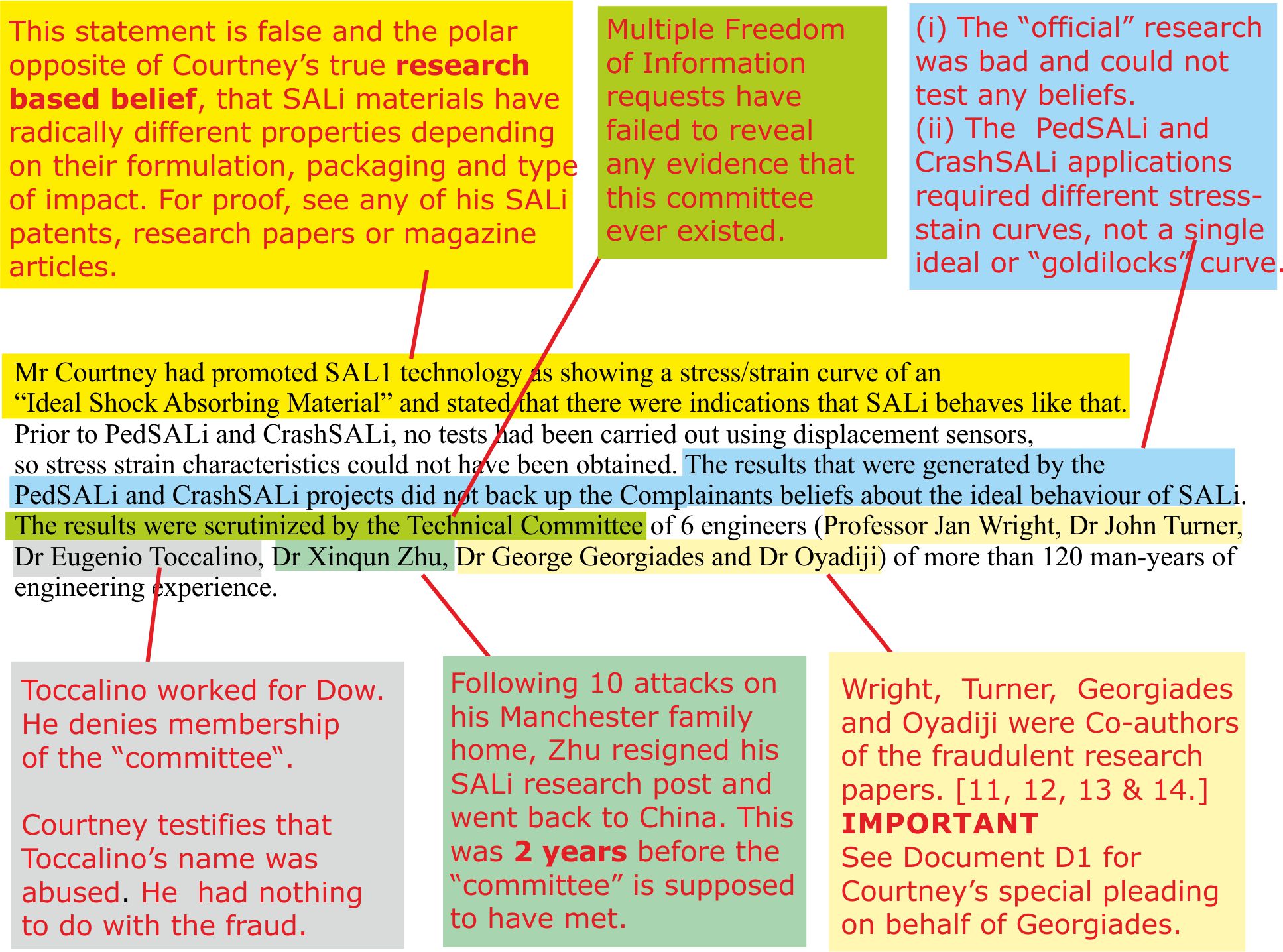
Click to see the Dow employee's denial of membership of this committee.
You should also note that the Report refers to "a stress/strain curve". This is false and misleading because SALi based impact absorbers present different shapes of stress/strain curves for different types of impact. Courtney would have been academically stupid to believe that a single curve was involved. A more serious criticism is that it contradicted his published [2, 3, 4] and unpublished [1,18, 19, 20] research.
1984 thinking
In order to believe this section of the Report any reader familiar with the PedSALi project has to abandon logic and use doublethink.
The whole purpose of the PedSALi project was to develop a "smart" SALi filled car bumper that offered a soft material type stress/strain curve for pedestrian leg impacts but a stiff material type stress/strain curve for other impacts. Courtney’s early research had shown this was possible [See the graphs near the top of this page.]
But according to the Report, the inventor was throwing away all of the advantages of his own invention by promoting SALi as a physically impossible “Goldilocks” material having a single stress/strain curve that was just right for many types of impacts. These ranged from the two types of bumper impacts to the far wider range of impacts and vibrations that should have been investigated in the CrashSALi project.
Courtney's true beliefs about how SALi worked were supported by independent research evidence from Cardiff [4] and Nanjing [5] Universities. The Panel were sent copies of these papers, but failed to mention them in their report.
This censorship of good research adds yet another layer of deception to the panels report because they wrote,
"Prior to PedSALi and CrashSALi, no tests had been carried out using displacement sensors, so stress strain characteristics could not have been obtained. "
Yes this was strictly true, but its use to support doublethink was deception. Both the Cardiff University research [4] and the Nanjing University research [5] that the Panel ignored included tests using displacement sensors.
[For illustrative evidence see Figure 3 taken from reference 5 on our CrashSALi page.]
It is also worth noting that it would have been physically impossible for the fictional "Technical Committee" to have tested Mr Courtney's true belief that a SALi filled bumper offered different types of stiffness depending on the type of impact because the University research [12, 13] failed to include bumper-to-bumper impact simulation tests.
Quality control underpins trust in British science. We must not allow a Formal Enquiry Panel to lower our standards by getting away with creating false evidence to hide research fraud.
Summary of this section
- The Formal Enquiry Panel dodged an investigation into the original research fraud by writing a story about a “Technical Committee” that never existed.
- There is clear evidence that the Technical Committee could not have existed.(i) One purported member has provided a written statement denying that he was a member.
(ii) A second purported member resigned from his post and returned to China two years before the committee was supposed to have met.
(iii) Freedom of Information requests submitted to Manchester University have failed to unearth any evidence of the existence of this committee. - In order to make their case, the Panel had to create a false set of beliefs that they attributed to Courtney. These “beliefs” were bizarre and made Courtney look stupid by academic standards.
- The false beliefs attributed to Courtney were the polar opposite of his true evidence based beliefs.
- Courtney’s true beliefs, along with supporting evidence had been published in a journal paper [3]. The Panel had access to this paper and made indirect reference to it in their report.
- It was Courtney’s true beliefs that attracted the interest of Dow and later won EPSRC funding for the PedSALi project.
They were referred to explicitly in the Manchester University funding proposal to the EPSRC. - The committee is supposed to have tested Courtney’s beliefs against the PedSALi research evidence. But this research was flawed and contradicted the laws of physics.
- Courtney’s true beliefs about the “smart” variable stiffness behaviour of a SALi filled car bumper could not have been tested because the Manchester University researchers failed to carry out the necessary experiments. (But they claimed EPSRC funding for the work!)
- Cardiff University subsequently carried out the required experiments and published their results. They were in line with Courtney’s predictions. A copy of the Cardiff research paper [4] was presented to the Panel, but is not referred to in their report.
- The Formal Enquiry Panel that created this secondary fraud consisted of the Heads of Physics and Maths at Manchester University and a representative of the UK Research Integrity Office.
For shear chutzpah, can any other research fraud in history trump this?
Refusal to face up to painful evidence about criminal activity
Exhibit 44 and Document C1 (Section 6.5), 19 and 44 provide proof that the Formal Enquiry Panel was aware of Dr Zhu’s Manchester home being attacked on ten occasions
They also provide proof that the Panel were aware of research materials supplied by Dow Chemicals being "stolen" from Dr Zhu’s work place. You will also read that the Panel were aware that Dr Oyadiji and Professor Wright had blocked Courtney's demand for the police to be called in. Instead, Dow was accused of not supplying the University with sufficient research materials.
Document C1 (Section 6.6), 7 and 19 provide proof that the University withheld information from Dow and Courtney that Dr Zhu wished to resign following the attacks on his home until his resignation had been accepted and he had booked his flight back to China.
Click to see Bill Courtney's first email complaining about this deception.
If you use The Freedom of Information Act to obtain a copy of The Formal Enquiry Report from the University, you should note that the Report contains no references to any of the following criminal law issues:
(i) The theft of Dr Zhu’s research materials from the University,
(iii) The ten attacks on Dr Zhu’s Manchester home,
(ii) Courtney’s concerns that Dr Zhu was being intimidated but the University refused to call in the police to investigate
(Document C1 (Section 6.5) and Exhibit 19),
(iv) Dow’s hard copy letter of complaint to the University that they had been kept in the dark about Dr Zhu’s crime victim problems and resignation until it was too late to help him. (Exhibit 7)
The related financial fraud
- Was the Formal Enquiry Panel presented with any hard evidence of financial fraud?
- Bill Courtney presented three strands of argument to support his assertions of financial fraud:
(i) As discussed on this web page, the PedSALi research was fraudulent. Consequently, any claim for full expenses must also be fraudulent.
(ii) In breach of the terms of the collaboration agreement, two trips were made to America to promote the fraudulent research findings. These trips to Virginia Beach and San Diego, California were made at the British taxpayers expense.
[Evidence of this foreign trip fraud was clear from several documents submitted to the Formal Enquiry. See for example Document C1 (11th Challenge.)]
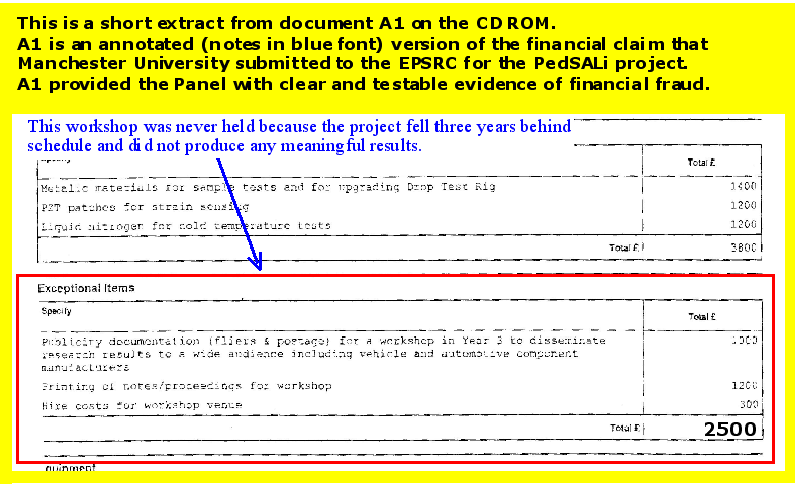
(iii) Claims were made for (a) trips to Dow Chemicals UK Headquarters to present the Manchester University research findings and (b) for hosting an event where the findings would be presented to the European automobile industry. These were supposed to be key milestones in the successful completion of the project.
None of these activities took place, but by claiming for them, the University gave the EPSRC the false impression that the milestones had been passed.
[Detailed evidence was presented to the Panel in Document A1.]
- How did the Panel respond?
- Their Report claims,
"The Panel could find no evidence of misuse of research funding."
In response to the testable evidence of financial fraud presented in Document A1
it stated,
" The Panel did not uphold this allegation."
[Gleeson, Duck and Fernandez, Formal Enquiry Report, University of Manchester, January 2010.]
Here is an illustrative example of the tricks used in the Formal Enquiry Report to create a smokescreen around the financial fraud:
As the lead partner, Cheshire Innovation kept the Department for Transport (DfT) regularly informed about the problems that the project was facing.
By April 2004 the University had failed to deliver any results to Dow, so Dow were unable to start their agreed work programme.
The DfT proposed a meeting of the project partners in London on April 27th 2004, to try and get the project back on course.
However, after hearing Dow’s side of the story and reading the discussion document submitted by the lead partner, the DfT cancelled the meeting at 24 hours notice.
The Formal Enquiry Panel was presented with several documents that made this position clear. But, instead of recording the truth, the Report includes a blatant lie that damages Courtney's professional reputation,
"An arbitration meeting was scheduled for 27 April 2004: this was cancelled because Mr Courtney refused to attend."
[Gleeson, Duck and Fernandez, Formal Enquiry Report, University of Manchester, January 2010.]
For proof that this was a blatant lie and that Mr Courtney was desperately keen to attend the meeting to clear his name, click here. If you scroll down to the foot of the linked web page, you will find proof that Courtney had bought his train ticket to travel to London for the meeting.
Other criminal deceptions
The British taxpayer funding for the PedSALi project came mainly from the EPSRC.
As lead partner for the PedSALi project, Bill Courtney had complained to the EPSRC about the Manchester research fraud. Initially the EPSRC planed to hold its own enquiry, but subsequently agreed to accept the findings of the Manchester University investigation.
- What did the EPSRC learn from the Report about the theft of Dr Zhu's PedSALi research materials, the ten attacks on his home close to the University and the University's refusal to call in the police?
- The EPSRC remained ignorant of the personal nature of the criminal damage suffered by Zhu's family because the Formal Enquiry Report merely explains Dr Zhu's resignation by referring to
"the crime situation in Manchester that had affected his family."
[Gleeson, Duck and Fernandez, Formal Enquiry Report, University of Manchester, January 2010.]
To verify the truth about the ten attacks on his family home, you will need to obtain a copy of Dr. Zhu's resignation letter from Manchester University.
The links between PedSALi and CrashSALi
- Why was the CrashSALi project launched at a time when PedSALi was already causing so many difficulties?
- Manchester University had an excellent business arm, Manchester Innovation Ltd (MIL). MIL was extremely supportive to Bill Courtney and Dow. It was very frustrated at the massive delay in starting the PedSALi project (see the timeline above) but could do nothing to help because Dr “Tunde” Oyadiji was sitting on the EPSRC funds and nobody within the Engineering Department was prepared to challenge him.
MIL suggested that a second project (CrashSALi) with Courtney holding the purse strings might put pressure on Oyadiji and stimulate PedSALi progress. This was a last option for saving PedSALi, so Courtney readily agreed.
You can get an insight into this strategy from an MIL email presented to the Enquiry as Document 5.
Here is an extract, “It would be good when we get the money to sit down with Tunde and try and make it blatantly clear what the University’s obligations in this project are!”
Unfortunately, as can be seen from Document C1 (4th Challenge), the strategy backfired in the chaos following the theft of research materials, attacks on Dr Zhu’s home, and his subsequent resignation.
In spite of Courtney's recommendation in Exhibit 14 that the key person from MIL be interviewed, the Panel failed to do so.
Their Report fails to make it clear that CrashSALi was a last desperate effort to save the PedSALi project. Yet again, as readers of the Report, the EPSRC was misled.
The Formal Enquiry Report Conclusions & Recommendations
The Report ends,
The Panel found no evidence of research misconduct on the part of Dr Oyadiji and did not uphold any of the allegations related to this contained within Mr Courtney’s complaint.
The Panel make the following recommendations to the Deputy President:
- That the University should look carefully at the role of honorary staff and ensure that their rights and responsibilities are clearly stated in a contractual agreement.
2. That the University should seek to restore Dr Oyadiji’s reputation if it has been damaged by the complaints that Mr Courtney has made against him over the years.
3. That the University should seek to ensure that the papers blocked by Mr Courtney are duly submitted for publication and any unpublished results are allowed to be published without such blockages in the future. “
[Gleeson, Duck and Fernandez, Formal Enquiry Report, University of Manchester, January 2010.]
Bill Courtney comments
There are many reasons why the Panel's conclusions are corrupt. Here are the main ones for fraud busters to investigate.
1 Courtney presented detailed evidence to the Panel that Dow was unable to start its work on the PedSALi project because the Manchester University work was invalid and worthless.
But the Panel made a self contradicting excuse for not examining this evidence. click here to see their excuse.
2 He presented detailed evidence to the Panel that the EPSRC and others had been misled because the researchers only published fraudulent data relating to ineffective elastic SALi packaging.
But, instead of examining the evidence, the Panel created a ghost committee that is supposed to have examined Courtney's evidence at an earlier date and concluded that he was wrong.
3 The CrashSALi project
Courtney presented the Panel with evidence verifying that the University researchers had tested the wrong materials. Also, that instead of fulfilling their contractual obligations and doing the work correctly, Manchester University used their solicitors, Eversheds, to intimidate Courtney.
But the Panel did not address either of these issues.
4 The investigation failed to meet two internationally recognised standards of justice:
4.1 Failure to reveal evidence During and after the Enquiry, Courtney was kept completely ignorant of any of the evidence submitted to the Enquiry by the University party.
On reading the Panel’s report is was clear that many false statements had been made, both about him and Dow Chemicals.
4.2 Failure to use witness evidence in a balanced manner
Honest witnesses not called
According to the Report, two key witnesses that Courtney had named to the VUM Vice-Chancellor, were not interviewed. These were Dr Michelle Cooper (pre amalgamation, at MIL, the business arm of the University) and Professor Steve Reid (Engineering, UMIST).
Valid testimony not cited
In an e-mail to Courtney, a Dow representative claims to have submitted written evidence to the Enquiry.
But the Report states that the Panel received no evidence from Dow. Based on past behaviour, Courtney trusts the Dow representative to be the honest party.
A biased witness was presented as "independent"
In 2003, the University had provided Dr Turner as an “independent” chairman with referee powers to help resolve the research disputes between Dr Oyadiji and Professor Wright on one side and Dow Chemicals and Cheshire Innovation (CI) on the other. But Dow and CI subsequently discovered that he was a one of Dr Oyadiji’s closest research colleagues. No Dow representative attended meetings after this discovery.
Courtney called for Turners resignation as Chairman but he remained because he was outvoted by Oyadiji and Wright.
Courtney provided the Enquiry Panel with evidence that Dr Turner’s behaviour should have been investigated. However, Dr Turner is still recorded as an “independent” witness in their Report.
Other evidence that Dr Turner was not an "independent person"
First example
The following annotated extract from the Manchester University web site provides evidence that you can check.
(Web page information last verified 3 July 2018.)
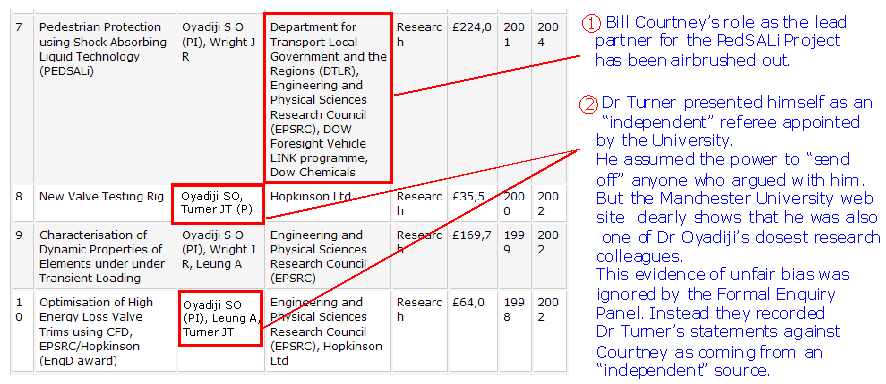
Second example
Quotes from Dr Turner's letter introducing himself to Dow and Cheshire Innovation as the University approved "independent" third party. [Presented to the Enquiry as Exhibit 8.]
"I should become involved as an independent person in an attempt to assist and resolve the difficulties."
“I see my job as essentially similar to that of a referee, ensuring ‘fair play’ between the different parties, issuing ‘yellow and red cards’ should these be appropriate, and keeping the project on course to a successful outcome.”
In reality, this meant that Dr Turner overruled Courtney's objections about bad research being tolerated.
The bad research came in three forms:
(A) The University researchers interpreted their results using muddled thinking that contradicted the laws of physics. This meant that the results looked superficially plausible but were meaningless and could not be used by Dow.
Even though Dr Turner had been appointed by Manchester University he did not have the power to wave red cards and "send off" the laws of physics.
If you are familiar with Newton's laws of motion and the laws of conservation of energy and momentum, you can check this hubris for yourself.
(i) To see a "law defying" journal paper resulting from the referee's intervention, please click.
(ii) Please click to see one of Bill Courtney's written warnings that the University researchers were ignoring the laws of physics. This example has been selected because it was also copied to the EPSRC.
(B) The University researchers willfully used elastic packaging the rendered the SALi impact energy absorbing mechanism ineffective. As you can see from this linked web page, Dr Turner shifted the blame for the bad research on to Dow by falsely claiming that they insisted on the bad research being done.
(C) There was also bad research by omission because in spite of reminders from Courtney during Dr Turners time as an intermediary, the University researchers failed to carry bumper-to-bumper simulation tests that would confirm the PedSALi bumpers "smart" properties.
4.3 Intimidation by the "referee"
Examples of Dr. Turner’s intimidating behaviour were presented to the Panel in Document C1.
To read about the most serious case of intimidation Scroll down to “4th challenge to the right of the University to pursue CI for debt recovery”.
Summary of what you will find
The “referee” starts his work in a very encouraging manner by offering Courtney compensation for the University mismanagement of SALi research. This will take the form of a rebate on the research fees for the CrashSALi project that is 75% public/25% Courtney funded. But Dr Turner changes his mind when he learns that the rebate savings will be used to fund good SALi research for Dow at sister university, UMIST.
A short meeting with the Manchester researchers plus an engineer from UMIST is held. At the end of the meeting, the UMIST man is escorted from the room by Dr Turner but Courtney is instructed to stay seated. On his return the "referee" chastises Courtney for his "stupidity" in failing to understand "plain English".
"Compensation" simply means that Courtney is excused from paying the University costs incurred in finding a replacement for the PedSALi research assistant who has resigned. (Following the attacks on his home and other problems.)
The "referee" rules that he is right and Courtney has to accept it.
The UMIST research is not done and Dow is left with nothing but the physics defying Manchester research.
Courtney is concerned because Turner is blocking research that, even at this late stage, may save the PedSALi project. As explained in Document C1, this ruling will blossom into legal intimidation by the University solicitors. [CrashSALi page.]
Courtney protests to the University,
"This form of “compensation” is equivalent to the form of “protection” offered to small businesses by criminal gangs."
(Document C1.)
Courtney also protests at the next meeting with the funding bodies. See Footnote 8, towards the end of Document C1
Courtney describes Dr Turner's intimidating behaviour at the earlier meeting and calls for him to step down because he has failed to declare a research interest and has demonstrated bias.
Turner refuses to step down, claiming to have let Courtney off lightly on the earlier occasion.
He boasts,
“I was not intimidating. When I give people a real bollocking, they don’t know what’s hit them for two days.”
Six members of the University and three representatives of the Department for Transport / Foresight Link witness this complaint and boast but say nothing. Nobody from Dow or UMIST is present. (Dow did not send a representative to any subsequent meetings.)
Dr Turner continued in his "referee" work until the project eventually failed.
The Panel’s response
Instead of Courtney’s complaints about Dr. Turner’s intimidating (and possibly criminal) behaviour being investigated, Dr. Oyadiji was selected as a scapegoat, with Turner appearing as an "independent" witness.
The Report records,
" In June 2003 Dr John Turner of the University of Manchester was appointed as an independent person to assist to resolve the difficulties between the University of Manchester and the industrial partners."
[Gleeson, Duck and Fernandez, Formal Enquiry Report, University of Manchester, January 2010.]
- Did Courtney attempt to get the Report retracted?
- Yes, but he faced a problem; who should he appeal to?
The Formal Enquiry had been managed by the University Research Governance Office so it could not provide an independent "appeals court.".
Instead, Courtney appealed to The University of Manchester Institute for Science, Ethics and Innovation for their honest intervention. Click here to see a copy of the letter he sent.
The Institute ducked the problem by passing his appeal on to the University Research Governance Office.
This Office refused to examine Courtney's evidence that the Panel had committed secondary fraud.
Here is an extract.
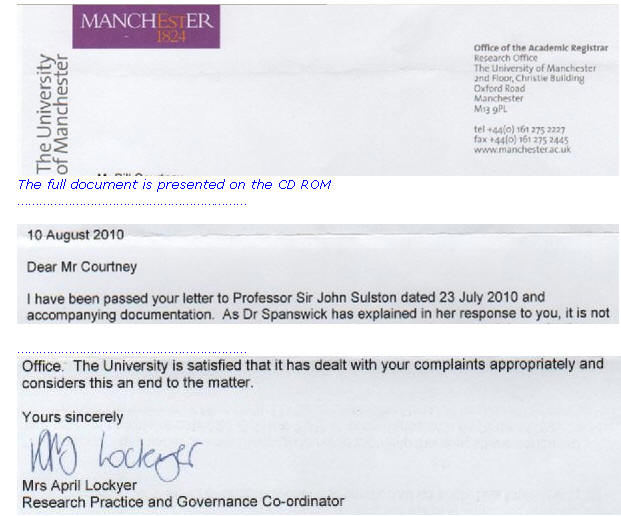
Comment
Bill Courtney is "A Manchester man" by birth and long association with the University. He recognises that the vast majority of University staff are doing good honest work and has enjoyed working with many of them. Appendix Four provides evidence that he "put his money where his mouth is."
But Bill's pride in his local University does not extend to tolerating fraud.
A final effort to fight fraud from inside Manchester University
Bill tried to embarrass members of the Institute for Science, Ethics and Innovation into speaking up for truth within the University.
He did thus by sending all listed members a testimony and inviting them to respond.
The tactic failed. So, with a heavy heart, he has gone public.
- Was Manchester University warned that comprehensive details of the Formal Enquiry fraud had been published online?
- Yes. Please click to see the proof.
Appendix 4
A4.1 How the chance to develop a SALi research hub was wasted
Research into SALi Technology has been done at six British Universities, in China, the USA and Ireland.
In the UK, only the PedSALi and CrashSALi projects have received direct public funding.
Prior to amalgamation in 2004, the Victoria University of Manchester (VUMAN) and the University of Manchester Institute for Science and Technology (UMIST) were separate institutions.
SALi research was carried out at both.
The publicly funded research at VUMAN was fraudulent. (See above and also the CrashSALi page.)
In contrast, low budget SALi research at nearby UMIST, was excellent.
[The good work at UMIST was done by Professor Steve Reid, Dr John Harrigan and their Masters Degree students.]
Bill Courtney hoped that post amalgamation the good researchers would prevail and that this embryonic SALi research hub would expand.
To generate funding for the hub, he handed over commercial negotiating powers to VUMAN, and agreed to it to taking 50% of all future royalties.
Dow Chemicals estimated that the PedSALi project alone would bring about $(US) 1 million/ year to the new University.
What happened in reality
Sadly, covering up fraud proved to be more tempting than developing a research hub.
When Bill Courtney's MP asked for time to investigate the matter, the new University created a smokescreen by falsely pursuing Bill for debt recovery. (See CrashSALi page)
The good researchers and the honest Business Manager that Bill trusted with his intellectual property all left the new University. Bill wrote to the University Vice Chancellor urging him to contact them, to hear their side of the story, but his suggestion was not taken up.
The legal threats affected Bill's health. He was treated for depression, became partially sighted and he ran out of funds. [For proof see Exhibits 9, 42 and Minutes, PedSALi Formal Meeting 9, 27 June 2003]
The SALi patents had to be abandoned and Bill's dedication to developing SALi Technology since 1986 came to nothing. In attempting to make Europe's roads safer, he lost his £140,000 retirement savings.
Meanwhile, it was better news for the University principal investigator who was promoted from Lecturer to Reader in Engineering.
SALi Technology is now being developed in China, but the Chinese have refused to cooperate with Bill or a British University.
A4.2 The sins of the fathers: Graphene
The cover-up of the SALi fraud at Manchester led to even greater losses in the British commercial exploitation of graphene.
Appendix 5
Here is the key clause from the profit sharing agreement between Cheshire Innovation (Bill's trading name) and MIL, the University business arm.
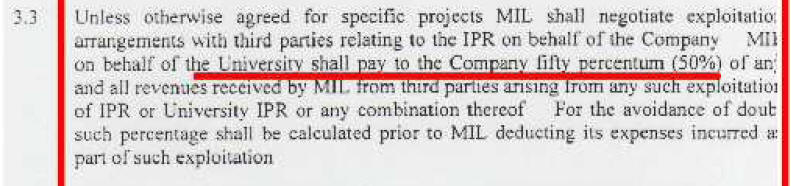
Bill was locked into a legally binding agreement that gave Manchester University the sole authority to negotiate with industry on his behalf.
Meanwhile, the University was hiding fraud by generating "evidence" that SALi was ineffective and that Bill himself was professionally incompetent.
The Formal Enquiry Panel were given proof of this Agreement, but it is not referred to in their Report.
Appendix 6
A letter from Lord Sainsbury to Graham Brady MP
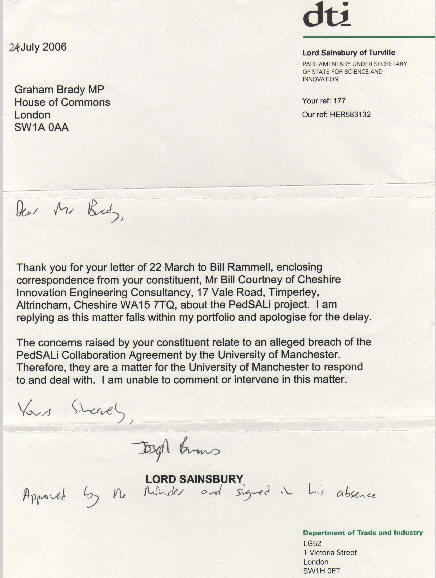
Bill Courtney comments
It is important for the reader to recognise that
(i) The University received its funding from the public purse.
(ii) The Department for Transport had appointed Cheshire Innovation (Bill's trading name) as the lead partner for the PedSALi project.
(iii) In keeping with his contractual obligations Bill had warned the EPSRC and the Department for Transport of the research fraud.
(iv) As a private person with very limited funds, the government should not have left him alone to police the spending of public money.
Implications for British science
1 Un-policed academic freedom encourages Meta-fraud
When University managers commit secondary or meta-fraud to hide research fraud the University system has no “Higher Court” to correct it.
At a time when funding is tight, Universities that tolerate meta-fraud gain at the the expense of their honest peers.
- Did Courtney make any attempt to find such a “Higher Court”?
- Yes, he presented his evidence of meta-fraud to the EPSRC, Universities UK, The UK Research Integrity Office, The Charity Commission, The UK Parliament Science & Technology Committee, Trade & Industry Committee, t The Department for Business, Innovation and Skills t The Royal Society, t Science & Technology Committee Inquiry into graphene t The Campaign for Science and Engineering and the Council for the Defence of British Universities.
Nobody wanted to know. It would appear that meta-fraud is too big and too painful for the British science establishment to face up to.
2 Un-policed academic freedom damages science
Since its birth in ancient Greece, science has been our most successful human endeavour. This success is based on a unique set of quality control systems. The whole edifice of science will collapse if we abuse these systems to hide embarrassing research failures.
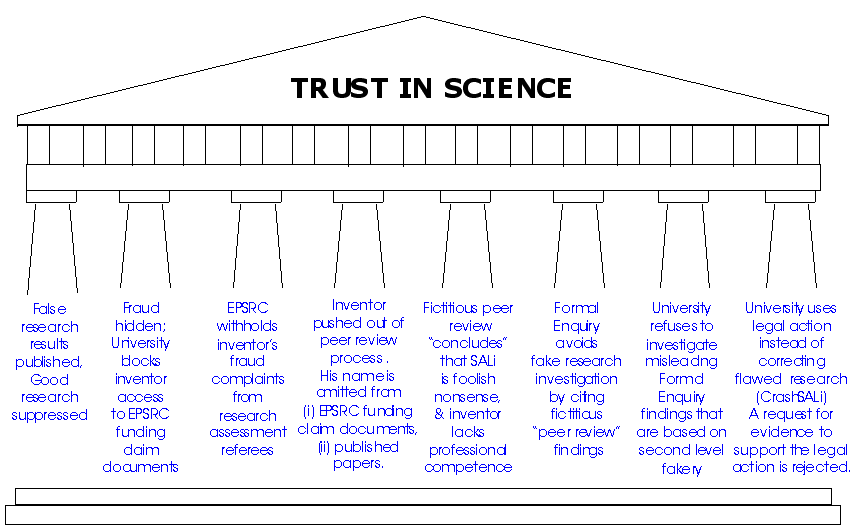
British science will be reduced to junk bond status if we abuse our science heritage.
If you have links to Manchester University or value science, don't just sit back and say "Oh dear."
To paraphrase Edmund Burke,
“For British science to fall from grace, it is only necessary that good scientists do nothing.”
- Would Bill Courtney be willing to work with Manchester University at a future date?
- Bill describes himself as “a proud Manchester Man.”
The vast majority of staff at the University had nothing to do with the SALi research fraud. Their professional conduct should not be judged by any of the evidence presented on this website. In order to demonstrate his belief in this statement, Bill would be happy and willing to work with the University developing any of his inventions.
BUT
- He does not tolerate research fraud and believes that the fraud problems described on this website need to be openly and fully investigated by a totally independent third party.
- Lessons need to be learned. As part of his contribution to this process he makes a number of proposals on the following web pages Science under attack and Innovation "apps"
- Fair compensation needs to be paid by the University for the distress and loss of commercial opportunities caused by the cover-up of the SALi research fraud.
If you have an academic interest in the links between Science, Technology and Democracy you may find the Manchester University course described on the following page of interest.
http://www.college.manchester.ac.uk/courses/?year=2015&semester=1&course=142
SALi and global warming
Bill Courtney’s original business plan was to use SALi as a cash cow invention that would generate the funds he needed to develop a new type of low cost green energy technology.
Unfortunately SALi research fraud at Manchester University undermined this plan and the green energy work has ground to a halt. As a result Britain may have lost a world leading position in fighting climate change. And as a consequence, your energy bills may be far higher than necessary.
Bill’s evidence of the damage done by university research fraud was presented to The House of Commons Science & Technology committee in March 2017.