title graphic


SALi - What Is SALi Technology(TM)?

SALi Technology provides a new way of protecting people and property from impacts, vibrations and shock waves.

A brief introduction to SALi

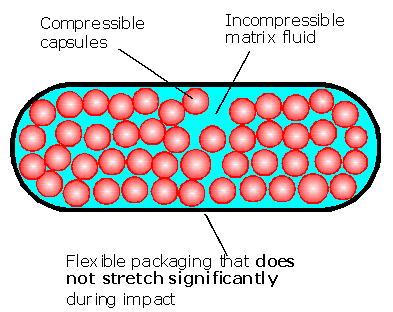
Basic SALi based impact absorbers consist of lots of small, elastic capsules blended with a liquid, mastic  or grease, with the mixture being retained in a strong package, which does not stretch significantly during an impact.

SALi impact absorbers = lots of elastic capsules + matrix fluid
                                      +  low stretch packaging

How does it work?

Diagram of SALi

Figure 1. During an impact the capsules shrink in size as they are compressed on all sides by the matrix fluid. The capsules, lubricated by the fluid, re-arrange themselves inside the package, so that the front face of the package takes up the shape of the impacting body.

In principle any liquid or grease which allows the hydraulic transfer of pressure can be used as the matrix fluid. In experiments liquid paraffin, glycol anti-freeze, wall-paper paste, Vaseline, mastic sealant and a range of engineering greases have been used as the matrix fluid. In order to maximise viscous damping very thick liquids having a viscosity similar to treacle are preferred. Non-setting gooey mastics are good because there are no leakage problems if the packaging is damaged. Shear thickening fluids are appealing because they allow the shape of the package to deform easily when bent slowly, but stiffen up during violent impacts. This feature is appealing in protective clothing, for example in pads to protect the spinal column of motorbike or equestrian riders.

Elastomeric capsules investigated include expanded polystyrene beads, polymeric microspheres, bubbles cut from bubble packing and narrow diameter, open ended, hollow tubes, with filaments of air trapped inside them.

All of the blends tested to date display useful impact absorbing characteristics. The diverse choice of materials available for making up blends of SALi should allow us to develop formulations to provide different elastic and viscous damping characteristics, to solve a wide range of impact absorbing problems.

Keeping the weight down

The basic SALi formulation as illustrated in Figure 1 has a single size range of capsules, with the matrix fluid occupying about 34% of the volume. The fluid fraction can be reduced to about 12% by using a blend of expanded polystyrene beads and polymeric microspheres. Blending is discussed in detail ob the Project advice page. (Se menu on the right.)

Features & Benefits of SALi
  • Correctly designed packages of SALi improve impact force reduction, compared with existing impact absorbing materials. Preliminary experiments also indicate that SALi has good blast mitigation properties.
  • SALi can be incorporated into helmets, gloves, shin pads, saddles, hip pads for Osteoporosis sufferers, car bumpers, suspension systems, fuel-tanks of aircraft, prefabricated structures in war zones etc.
  • SALi is re-usable, allowing it to accept many impacts. It is also good for the environment, because it can be recycled locally, without using expensive heat treatments. For example, old SALi based car bumpers, could be re-used as crash barriers.
  • Viscous versions of SALi offer "smart" properties, with the absorber increasing in stiffness as impact velocity increases.
  • Viscous damping forces are not transmitted through an impact absorber, so the forces behind the absorber are lower than the breaking force absorbing the impact.

 The importance of SALi can judged from the support we have received:

  • The Foresight Vehicle Programme part funded the PedSALi Project, which allowed us to work with The University of Manchester and Dow Chemicals, to develop soft, pedestrian friendly car bumpers. (£256k public funding.)
  • The CrashSALi project, to carry out preliminary investigations, into the use of SALi, to improve the crashworthiness of motor vehicles, and also examine the possibility of using SALi in lightweight vehicle suspension systems. (£45k public funding.)
  • Our NESTA supported Sassy Hats Project is concerned with developing a new generation of soft protective headwear. (£1k public funding.)

SALi - SALi Vs. Foam

Figure 2.

Illustrative diagram with text

Packaging SALi

Strong, low stretch clothing fabric forms a s suitable outer packing for many applications, e.g. hip pads, sports equipment and basic research work
For more violent impacts, e.g. crash  protection and military applications, glass fibre matting + binding resin offers a low cost alternative to Kevlar.

s

Figure 3

The left hand diagram  shows correct, low stretch packaging being used. The elastomeric capsules are compressed by the impact.
The right hand diagram shows the package stretching, with negligible compression of the SALi material.
 Cheshire Innovation owns patents relating to low stretch packaging - excellent for impacts.
 Nike own the patents relating to SALi type fillings in high stretch packaging - unsatisfactory for absorbing impact energy, but
excellent for gentle padding
, for example, wheel chair cushions.

Please note: "Shock Absorbing Liquid", "SALi" and "SALi Technology" are Cheshire Innovation trade marks. (TM)

Their use to describe products or research results where low stretch packaging is not used will be considered as passing off, liable to deceive the public or funding bodies.


An internet search has revealed that fake research passing off as an investigation in Cheshire Innovation's patented SALi Technology has been presented at two engineering conferences in the USA.  The work is fake because although papers cite our patents as the only background patents to the research, Nike's patented elastic packaging has been used, giving the impression that SALi Technology is ineffective for crash protection. 
The  university concerned carried out research into SALi Technology under the terms of a written licensing agreement with Cheshire Innovation. The authors were warned of their error in advance of publication. Written complaints have been submitted to the relevant university and conference organisers.
Researchers who wish to avoid being mislead by this fake research should contact us.

Find out more about SALi Technology projects

  • The Sassy Hats Project to develop a new generation of soft protective headwear. (NESTA funded.)
  • The PedSALi Project to develop soft, pedestrian friendly car bumpers.     (Foresight Vehicle Programme funded.)
  • The CrashSALi Project to carry out preliminary research into (1) the use of SALi in new low cost suspension systems and (2) improve the crashworthiness of motor vehicles, trains and other forms of transport. (SMART funded.)

Limitations to our technology

We specialise in impact, vibration and blast mitigating devices. Our markets, intellectual property and research data are restricted to  dynamic applications, where the stresses on the SALi materials vary rapidly with time. 

Next page