Using solar energy to desalinate water and produce electricity
Patent application Nos. GB 0511946.6, 0608208.5, 0618171.3
Introduction
Water plus Power (Warp) generators are proposed as a method for converting low grade heat into electricity, with the option of distilling brine to potable water as a by-product. Suitable sources of heat include:
On this page we will describe the solar powered version. The coal fired Warp generator and a more detailed technical can be found on the following page: Water plus Power (Warp) Generators
If you have a maths phobia, don’t be put off by the mathematical equations on the first diagram below. Most of this article is descriptive.
1 The basic solar Warp unit

Figure 1 A pressure drop exists between the evaporation and condensation chambers, because of the drop in vapour pressure. as it condenses out. The vapour is funnelled before it hits the turbine blades, in order to increase its kinetic energy. We envisage the vapour hitting the turbine blades with a velocity of the order of 300 ms-1.

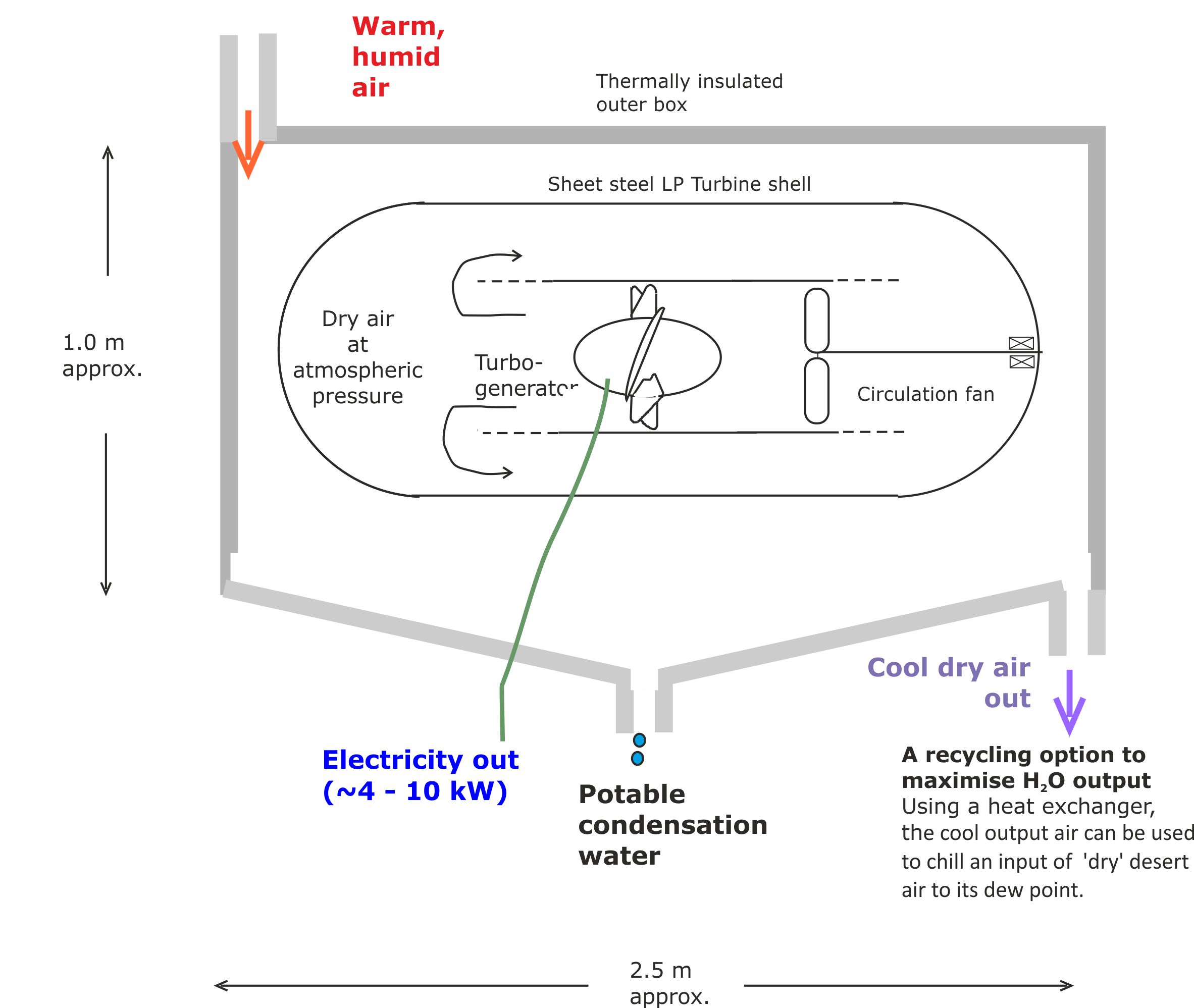
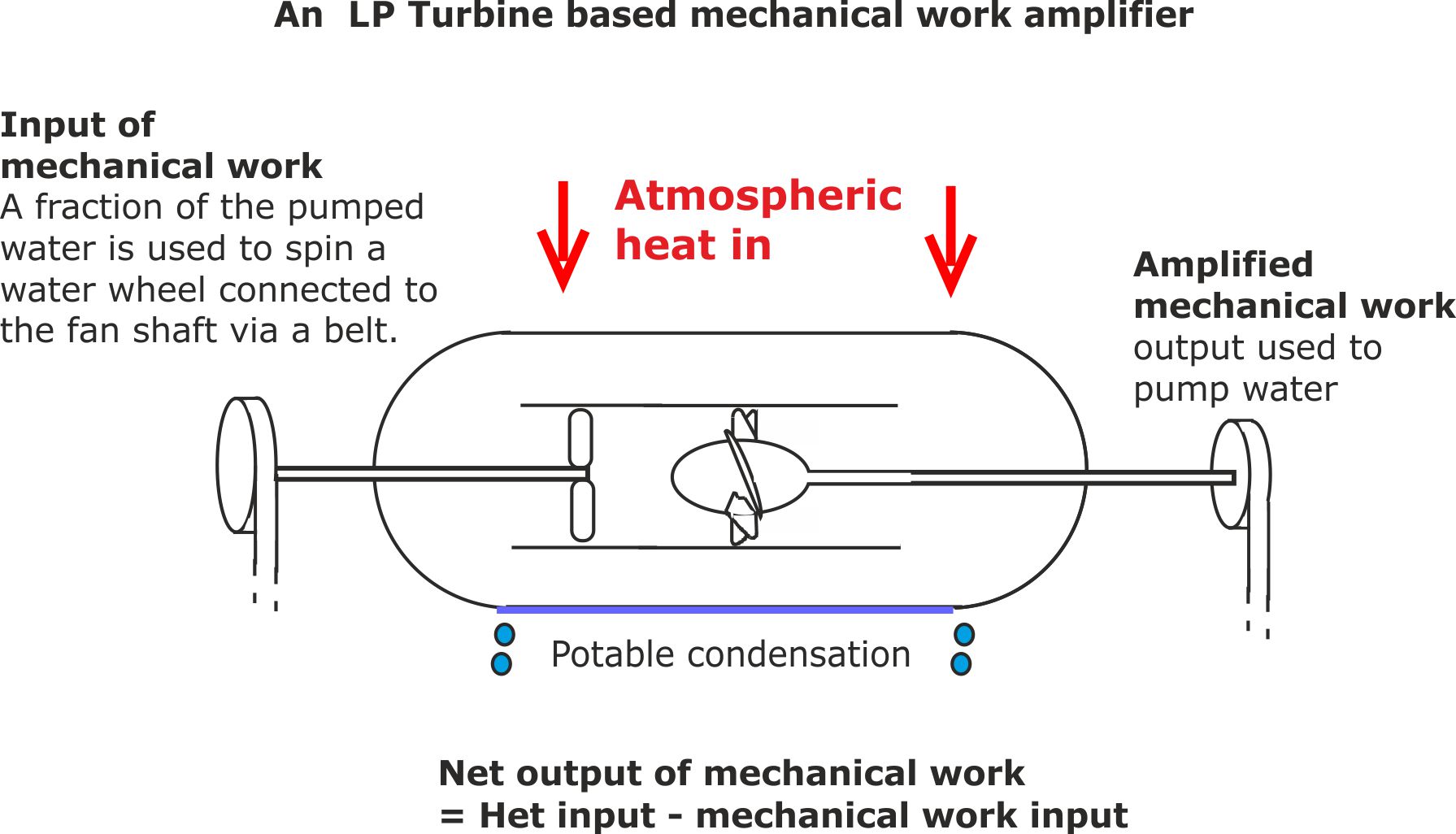
Figure 2. Most of the thermal energy is stored in the water vapour in the form of latent heat. A single turbo-generator can only make a modest improvement to the rate of condensation.
A marginal improvement could be made by using a chain of three or four turbo-generators, but beyond this, we would “run out of steam” because the steam temperature would be too low for the turbines to operate.
2 Efficient Warp designs
If you are familiar with steam turbine design, then in studying the figure below, it is important to bear in mind that the vapour leaving the evaporation chamber is saturated. This differentiates Warp generator behaviour from conventional s power station steam turbines, where unsaturated, super-heated steam is used. (Super-heated steam is conventionally produced by warming the steam, following the evaporation process.)

Figure 3 The key point we wish to make is that the condensation process releases latent heat, thermally regenerating the vapour. It is lifted to a temperature only slightly lower than its temperature before entering the turbine.
[The molecular explanation for thermal regeneration is as follows: The vapour is super-cooled and thermodynamically unstable after passing through the turbine. The slowest moving molecules in the vapour have the highest probability of condensing out. This increases the mean velocity of the molecules remaining in the vapour state. At the macroscopic level, this increase in mean molecular velocity is manifested as an increase in vapour temperature.]
The thermal regeneration process significantly reduces the “running out of steam” problem, allowing us to employ a long chain of turbines. For the present paper, where we are making the case for both potable water and power generation, a chain of about 30 - 35 turbines is envisaged. This allows about 30% of the thermal energy to be re-cycled, enhancing the rate of water production. If water production is of secondary importance, virtually all of the latent can be extracted during one run through the system, using a chain of about 42 turbines. (Based on calculations carried out by graduate students at Lancaster University.)

Figure 4. A chain of turbo-generators can be used to convert about 70% of the energy locked up in the steam as latent heat. This improves the efficiency of the desalination process and generates commercially exploitable electricity as a by-product.

Figure 5. Conceptual diagram depicting a high efficiency Water plus Power (Warp) generator unit. Air is added to the system to prevent vapour being sucked towards the cool end of the evaporation chamber. The air exerts a high partial pressure at the cool end, with vapour pressure dominating at the warm end. The air fraction is altered during the working day, to ensure that the pressure inside the evaporation chamber is approximately equal to the prevailing atmospheric pressure. A slight pressure gradient is required inside both of the chambers, to ensure a circulatory movement of the air plus vapour mix.
Extracting 70% of the latent heat energy as shown in Figure 5 allows 30% to be re-cycled, increasing the rate of potable water production. If more turbo-generators are added to the chain, up to approximately 96% of the latent heat can be extracted on its trip round the system, but the potable water production rate would drop by 30%. Also, as we move along the chain, the output per generator drops as the vapour fraction of the vapour plus air mix falls.

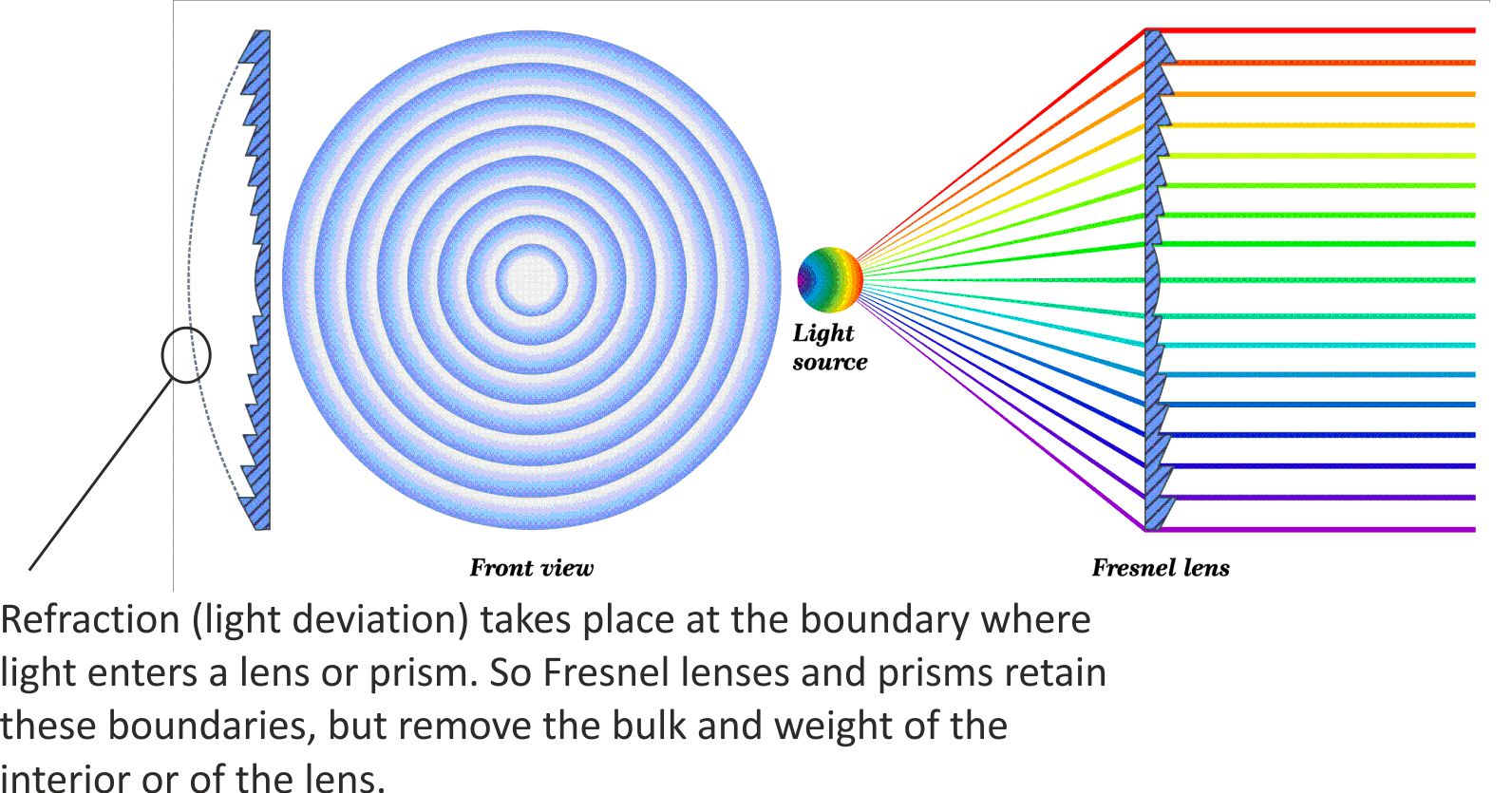
Figure 6. By using a canopy made up of cylindrical Fresnel thin lenses (i.e., micro prisms) the sun can be tracked throughout the day without the complexity of the moving mirrors commonly associated with large solar power units.

Figure 7. Plan view of a manifold system used to extract vapour from a family of evaporation chamber channels.
This design draws vapour from the channels in proportion to the rate they are generating hot water vapour.
3 Greening the deserts

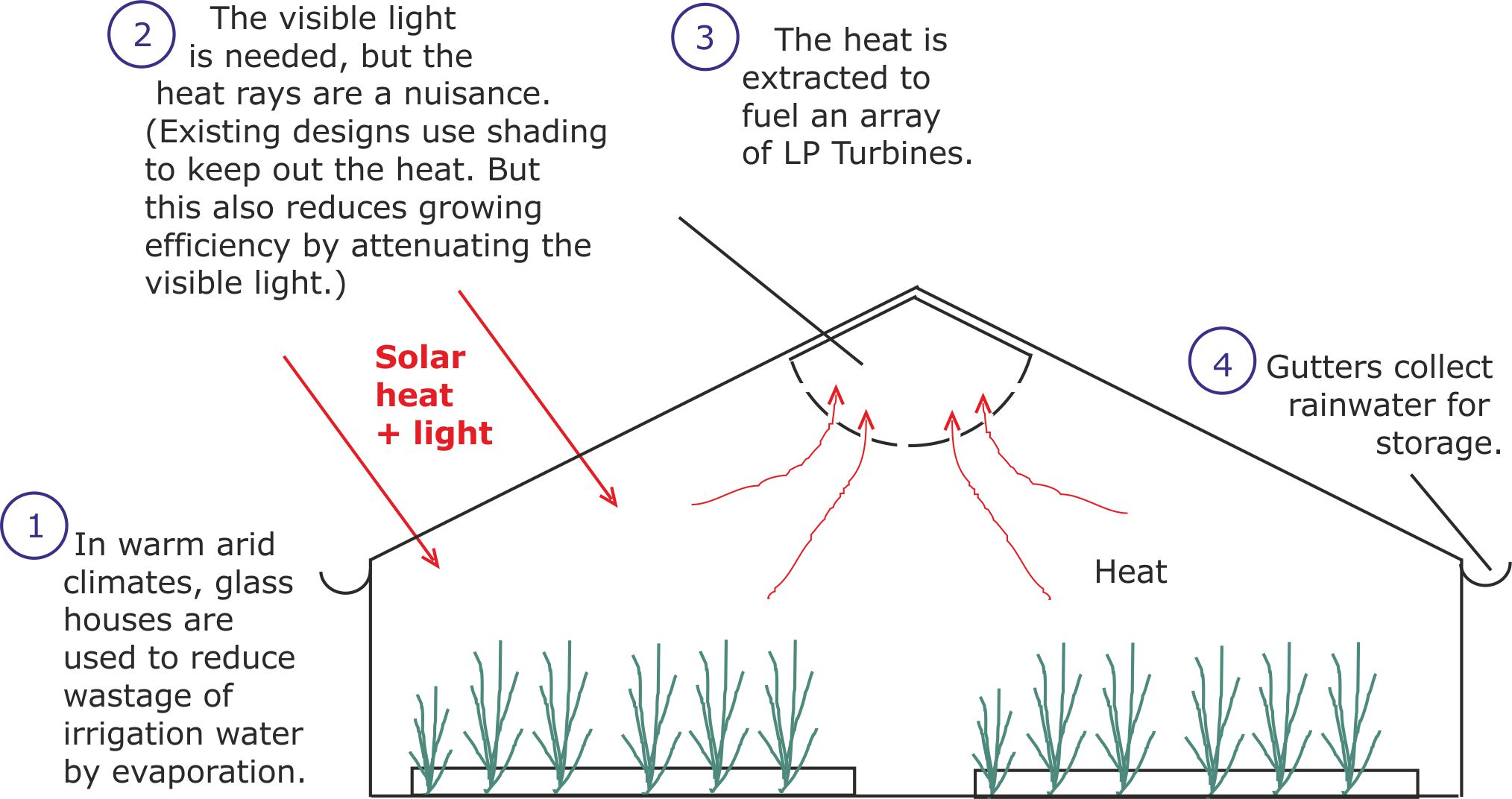
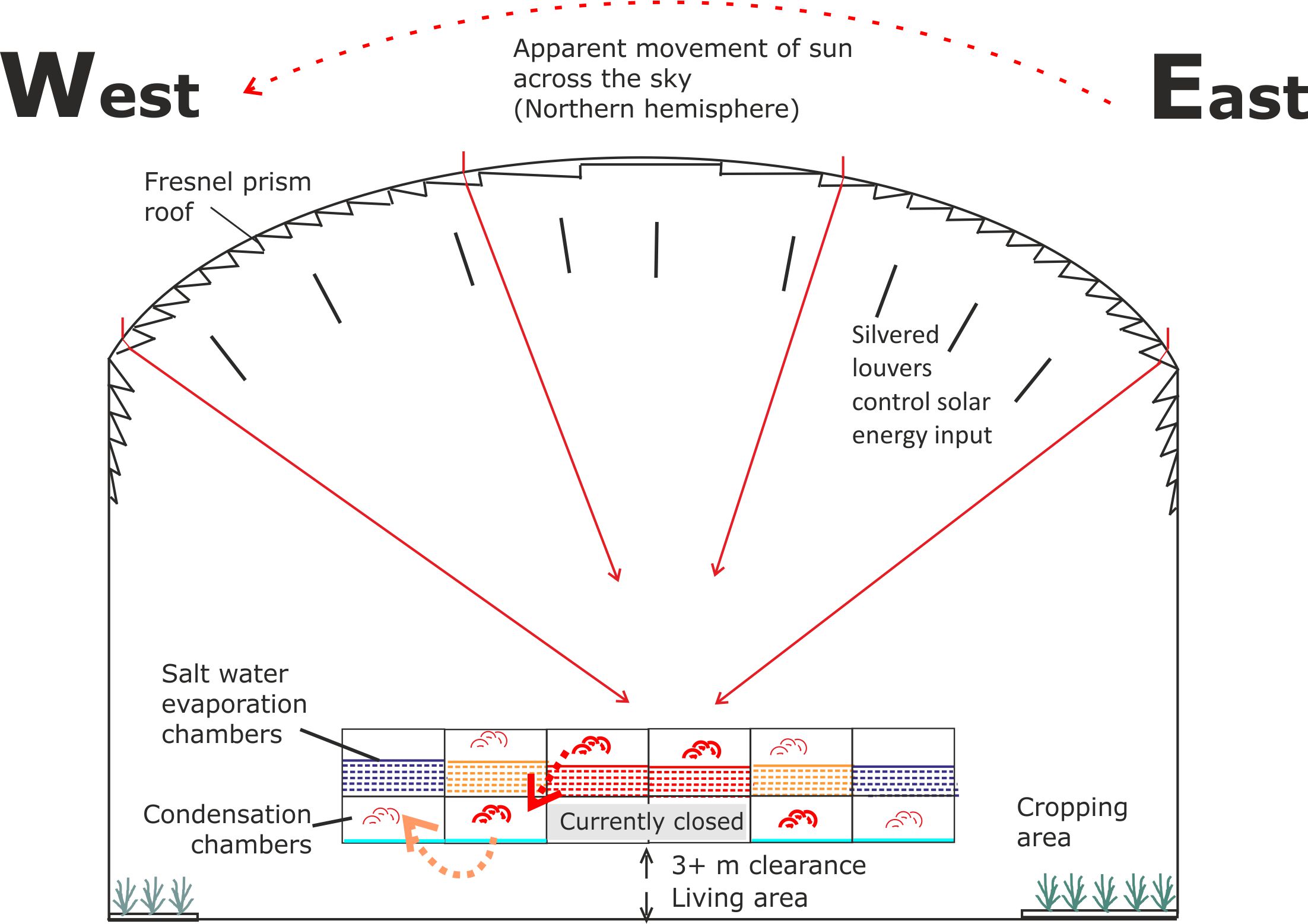
Figure 8. Comfortable humidity habitation and cropping zones can be created by adding external glass walls. Larger cropping zones and more intense focusing of solar radiation can be achieved by employing a higher, wider Fresnel lens canopy.
The cropping zones are only illuminated by scattered sunlight from the sky. In effect, the inner glazed zone, occupied by the troughs, acts like a giant heat pump, shunting heat away from the cropping zones. Photosynthesis will convert about 10% of the solar energy falling on to the leaves in to chemical energy inside the plants. Evaporation of water from the leaves of the plants provides further cooling. This system will allow people to live comfortably in the desert, without the need for air conditioning.
Waste plant material is dried out in the glazed cropping areas to release its trapped water content. The waste is burned in the late afternoon, to provide additional low grade heat, as the solar intensity declines. The carbon dioxide produced by the burning process is pumped into the uninhabited cropping zone, to enrich its carbon dioxide content and accelerate plant growth. The plant ash is used as a potash fertiliser.
24 hour power generation By combining solar powered Warp generators with gas turbine units; 24 hour/day electricity generation will be possible. The combustion gases for the gas turbines would be compressed hydrogen and oxygen, with the gases being produced during daylight hours from the electrolysis of water. Such gas turbine units would be far more efficient than conventional gas turbines, which waste a lot of energy compressing air, (only one fifth computable oxygen) in preparation for injection into the combustion chamber. The steam produced by the proposed combustion process can be condensed out to a vacuum, inside the condensation chamber, further increasing efficiency, compared with conventional gas turbines. The latent heat released by the condensation process would help to keep the solar powered Warp unit warm overnight, ready for firing up the next morning.

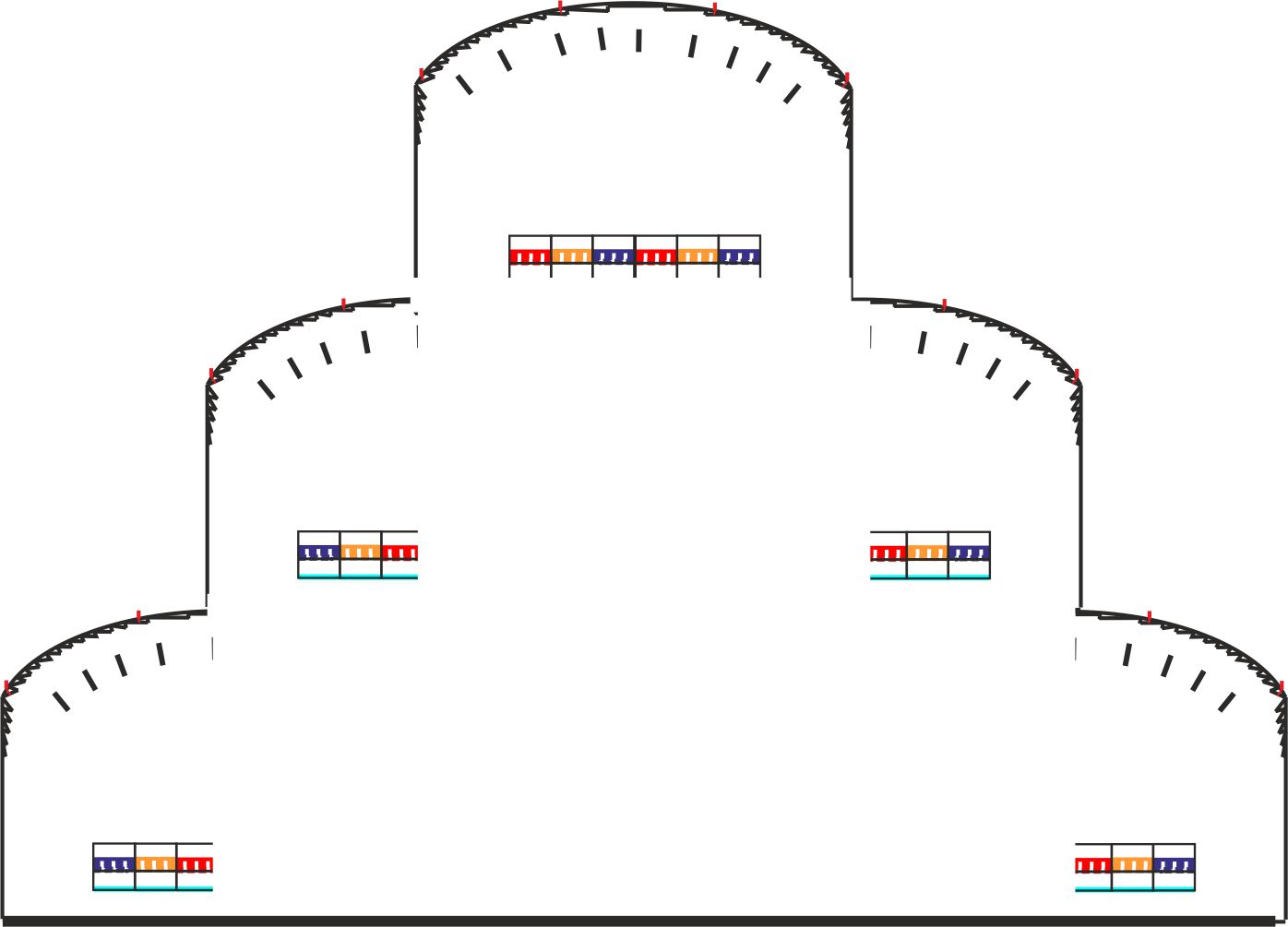
Figure. 9. Parallel solar Warp generators may be grouped under a common Fresnel lens canopy. Additional internal shading can be provided for pedestrians, cyclists and animal traffic.
High value exotic crops In the future, genetically modified crops are likely to be grown, to produce pharmaceutical drugs and other specialist chemicals. However, there are potential environmental risks, caused by the distribution of GM pollen. Growing such crops under cover in desert regions will reduce the real and perceived risks. The air from currently pollinating cropping zones could be drawn off in the late afternoon, for combusting the dried waste plant material. The enriched carbon dioxide inside the glass houses could be used as a marker, to monitor the leakage of pollen laden air.
The solar Warp concept can be adapted to meet a range of desert community needs. The diagram below shows a unit adapted for sewage treatment.

Figure 10. The re-cycled sewage materials are used to fertilise an enclosed meadow. The condensation water from the liquid sewage is used as drinking water for the cattle.
4 Approximate dimensions and potable water output for a Warp generator delivering 100 MW (108 Js-1) of power
Assumptions
(i) For these order of magnitude estimates, the energy dissipated when steam cools from 100oC to ambient temperature will be ignored.
(ii) 70% of the latent heat is converted directly to electricity, with 30% recycled
(iii) Effective solar intensity over 8 hour working day = 250 Wm-2
Values used:
Latent heat steam = 2.3 106 Jkg-1, Density of steam = 0.6 kgm-3
Estimates
Area of Fresnel lens canopy required = 108 W/250 W = 4 x 10⁵ m2
This area could be covered by a canopy 80 metres wide, 5 km long.
The potable water output/second would be [108 Js-1 x (10/7)]/[2.3 x 106 J kg-1]
= 62 litres of potable water/second
The yield over an 8 hour day would be 62 x 60 x 60 x 8 = 179 x 103 litres
= 179 m3potable water/day
The volume of steam leaving the evaporation chamber/second would be
[(10/7) x 108 J]/[ 2.3 106 Jkg-1 x 0.6 kgm-3]
= 103 cubic metres of steam leaving the evaporation chamber per second
N.B. The total volume output per second will exceed this, because of the additional air content. If there is negligible air seepage into the evaporation chamber, the air fraction is about equal to the water saturation pressure at ambient temperature. (4% of atmospheric pressure for a temperature of 30oC.)
We have assumed that the Warp generators operate 8 hours/day for 300 days/year, at an effective solar intensity of 250 Wm-2, This provides an output per square metre of 600 kilowatt hours/ m-2/year or 600 x 106 kW hours/km3/year.
5 Meeting the World’s energy needs

Fig. 11. The World’s desert assets. In addition to the true deserts shown, all the populated continents have extensive tracts of semi-arid scrublands. These could become economically productive regions if solar Warp cropping systems were introduced.
We include estimates for Iran and the USA, because of the diplomatic spin-offs of meeting their energy needs
|
Primary energy consumer (coal, oil, gas, nuclear, renewable) |
Total primary energy
consumption/yr (x109 kW h) Year 2004 |
Area of solar Warp required to generate equivalent amount of energy (km2) | Regional desert(s) used for comparison | Total area of desert(s) available. (x 103 kn2) | % of desert needed for solar Warp generators |
| Iran | 1 890 | 3.15 x 10³ | Iranian (Dash-e-lut) | 52 | 6.1 |
| USA | 29 417 | 49 x 103 | North American (Mojave + Sonoran) | 345 | 14.2 |
| Whole world | 130 678 | 217.8 x 10³ | All of Worlds true deserts | 15 013 | 1.6 |
For comparison, the Dutch horticultural industry has approximately 105 km2 under glass.
The primary energy statistics used for the above table are taken from the following web site: USA Energy Information Administration, http://www.eia.doe.gov/
Primary energy means coal, oil, gas, nuclear and renewables, but not electricity because this is a secondary form of energy, derived from one or more of the primaries. The energy date on the quoted web site is provided in quadrillion (1015) British Thermal Units.
The conversion facto from BTU to kWh is: 1015 British Thermal Units = 293 x 109 kWh.
6 Floating pontoon Warp generators

Fig. 12. Floating pontoon Warp This design could meet the power and water needs of cities on narrow coastal planes, where land prices are high or the hinterland is too rocky for building land based Warp systems. It also offers environmental benefits in coastal regions with wide continental shelves, where concentrated brine pumped back into the sea from land based desalination plants could adversely effect the local marine environment.
7 Desalination only plants
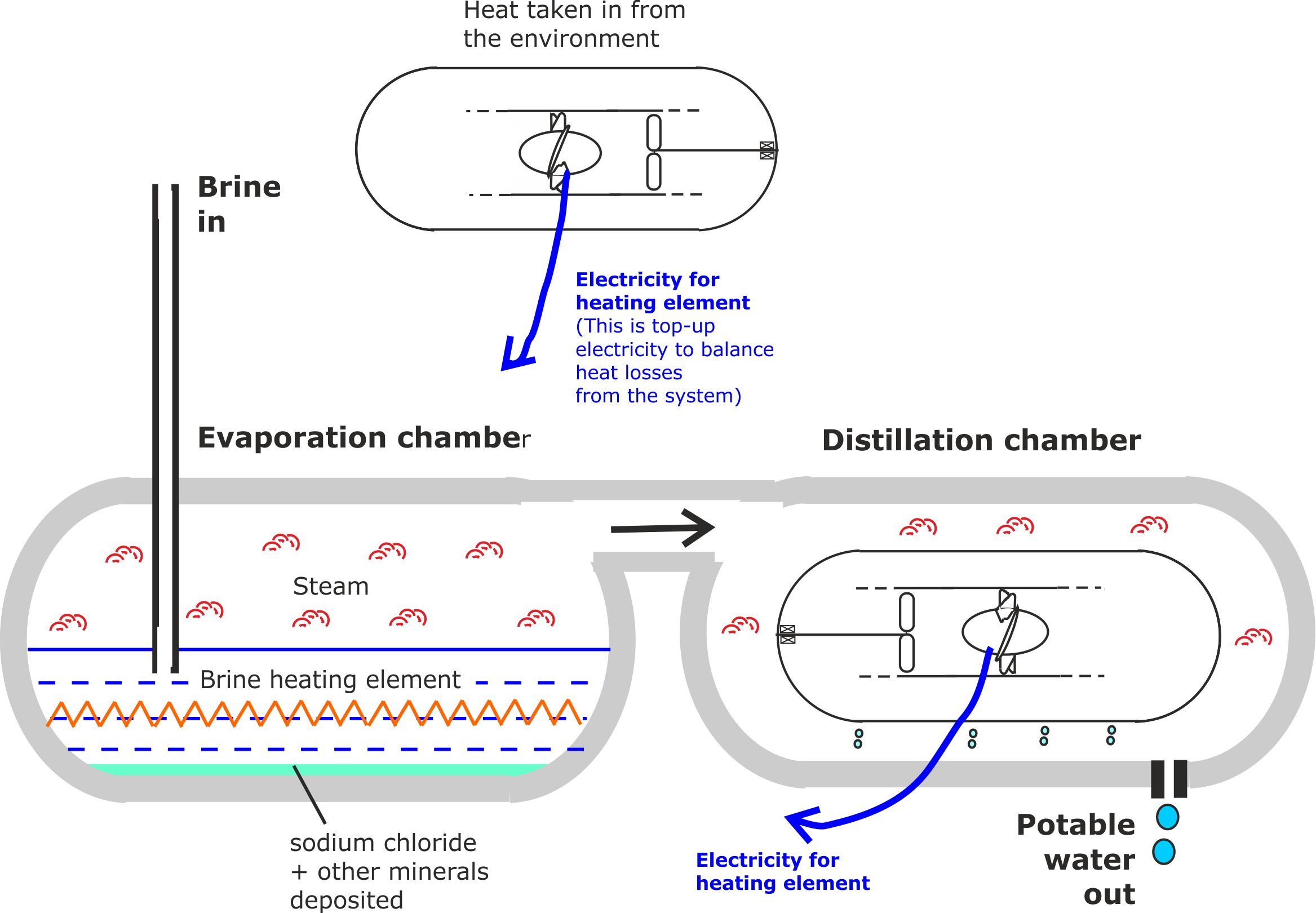
The Warp generator designs discussed above convert latent heat into an equivalent amount of electricity, to offer very efficient power generators. In a separate patent application we describe desalination only plants. These exploit the same thermal feedback features as Warp generators, but all of the heat released by the condensing vapour in the condensation chamber is fed back into the evaporation chamber, setting up a positive thermal feedback loop.

Figure 13. This desalination only design relies on convection currents to pump the vapour plus air mixture round the system. The amplification of the solar intensity, caused by the converging Fresnel lens system, increases towards the warm end of the evaporation chamber, to exaggerate the horizontal temperature gradient.
As the system warms up in the early hours after sunrise, the rate of evaporation will continue to increase, until a temperature is reached where the heat losses from the external walls of the system are equal to the rate of capture of solar energy. Based on the fact that eight times as much energy is required to convert 1 kg of water to vapour, compared with the energy needed to raise 1 kg from 30oC to 100oC, we estimate that the system described above will be approximately eight times as efficient, per unit solar collection area, compared with simple solar powered desalination plants. As a bonus, the new design also offers relatively cool, shaded cropping or habitation zones, to the sides of the evaporation chamber.

Figure 14. Heat can only travel from a warm body to a cooler one. This law of thermodynamics is particularly relevant for desalination only plants because of the high rates of heat flows. The multiple channels in the evaporation chamber help meet this requirement, because some of the channels are always in the shade.

Figure 15. In order to further enhance the rate of heat transfer from the condensing vapour to the evaporating brine, the base of the evaporation trough can be shaded from direct sunlight.
Slatted masks ensure that at least half of the trough base is always in the shade. The frequency of the slats is twice the frequency of the corrugations. Consequently, adjacent sections of the trough base having approximately the same slope are alternatively, relatively warm and cool. This helps to promote strong convection currents, shunting heat to the liquid surface.
Galvanised iron has adequate thermal conduction properties to cope with heat transfer demands. Fore example, its thermal conductivity of 80kW m-1K-1 would allow a 2.5 mm thick sheet to transfer heat at a rate of 16 MWm-2 for a temperature drop of 1 K (1 Celsius degree) between the two chambers.
NOTE If the production of green vehicle fuels interests you, please go back to the Water plus Power (Warp) Generators page and scroll down to Producing bio-fuels form algae, the Warp way, towards the end of the article.
Back to this web site home page