
Improvements to fresh water security include:
- Harvesting water from the atmosphere,
- Upgrading LP Turbines so that they can simultaneously generate electricity and desalinate sea water.
- Adding water harvesting and desalinating features to horticultural glasshouses.
-
Exploiting polluted underground water resources
1 Harvesting water from the air
The Earth’s atmosphere contains a small amount of water vapour that can be harvested. But the air needs to be cooled to a temperature know as its dew point, before any of the water can be condensed out. Below the dew point, harvesting water is still challenging because energy (latent heat) has to be extracted from the vapour, in order for it to condense into the less energetic liquid state.
In humid tropical air, the dew point is around 29oC, falling to below 4 oC for dry deserts air.
In Britain, the summer air has a dew point of around 10oC to 16oC, depending on the dampness of the air
In the basic harvesting systems described below, the shell of the LP Turbine must remain above the freezing point of water, to avoid ice forming on it.
1.1 Water harvesting using domestic sized LP Turbines
This design is suitable for use in temperate and tropical regions. Essentially, it is a standard domestic LP Turbine design, as described elsewhere on this website. But a heat exchanger has been added, to pre-cool the air before it enters the LP Turbine’s outer chamber. This allows us to maximise the amount of water harvested per unit of electricity generated.
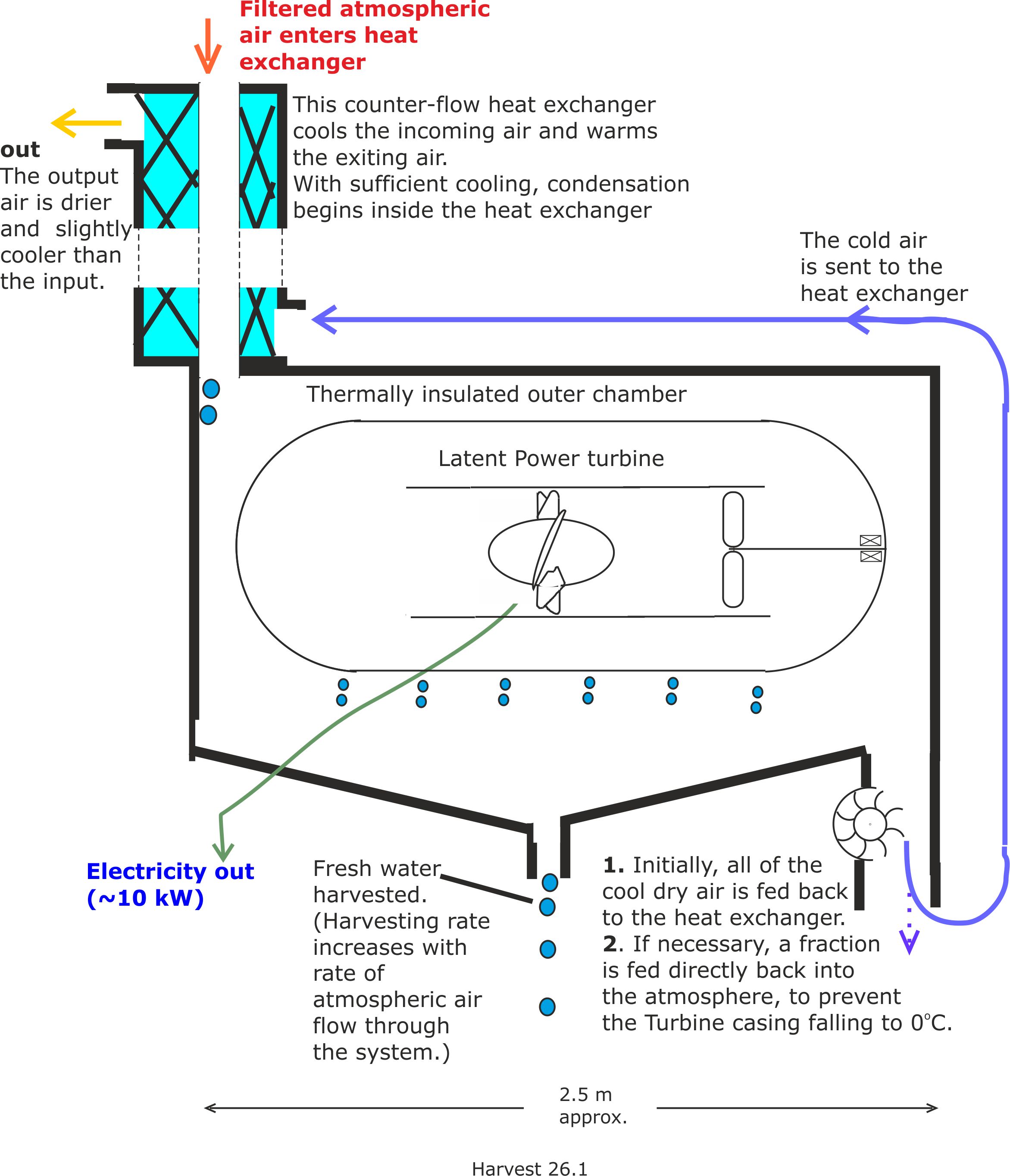
Figure 1. In the steady state, the counter-flow heat exchanger cools the incoming air to its dew point (and possibly lower) before it enters the thermally insulated chamber.
When the water vapour condenses, latent heat is released. This heat is then consumed by the LP Turbine.
The capacity of the LP Turbine to convert thermal energy into electricity limits the rate at which water can be harvested.
As a free bonus, this unit can supply an output of de-humidified air to indoor living spaces. During heat waves, when cool air is more important than dry air, the heat exchange could be bypassed, and the cold air blown into the building. But, this reduced the output of harvested water.
Climate change is making water supplies less reliable around the globe. So, it would be prudent for all domestic LP Turbine units to include a counter-flow heat exchanger, to minimise the demand on mains water supplies. However, harvested water lacks the minerals naturally present in rainwater. So the water needs to be re-mineralised before using it for drinking or watering plants.
1.2 Industrial scale water harvesting
This design can be used for harvesting moisture from air extracted from large indoor spaces such as vertical farms and horticultural glasshouses.
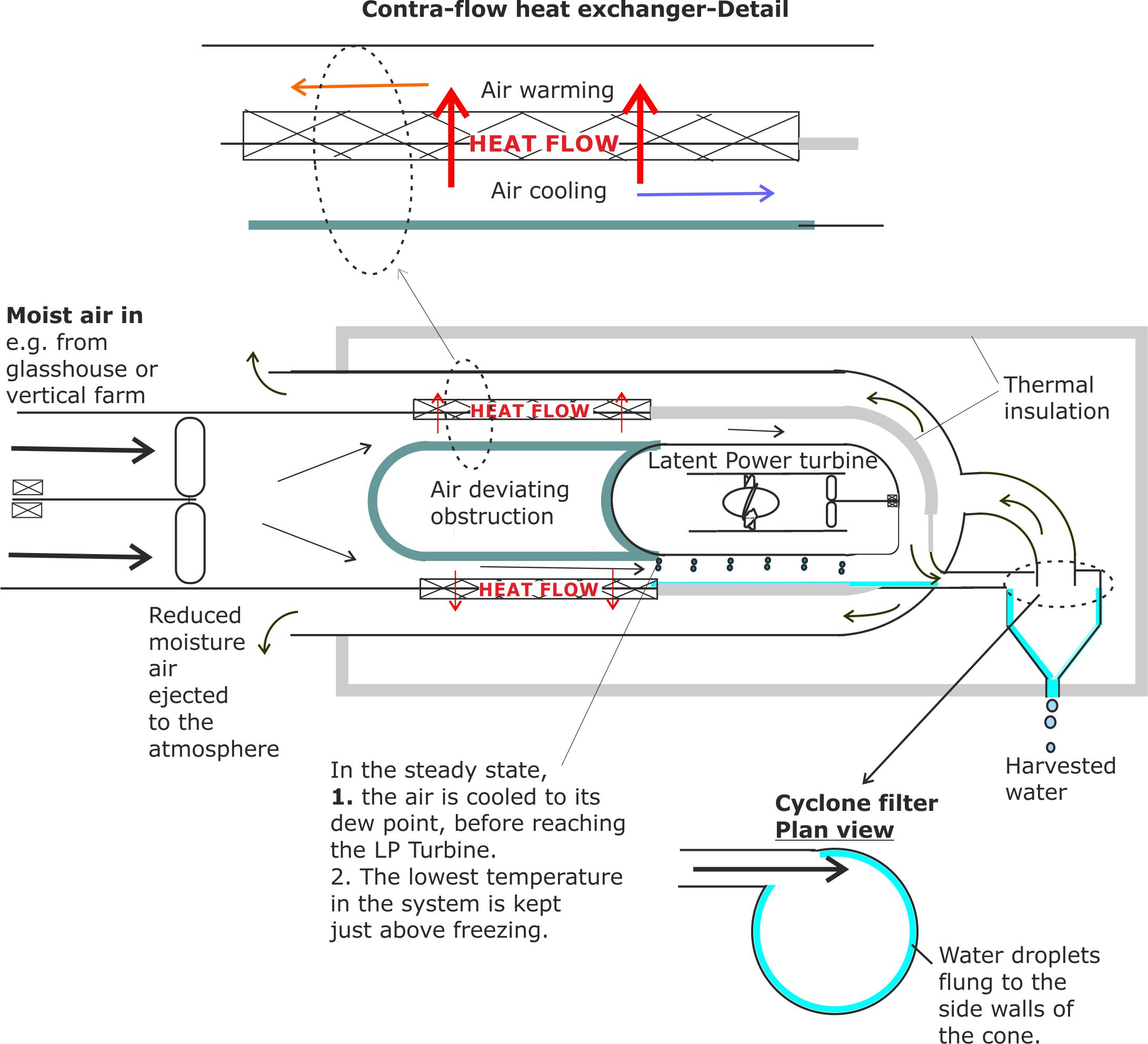
Figure 2. A large scale atmospheric water harvesting unit.
2 Distillation of sea water
According to existing technology, reverse osmosis is preferred to distillation because it requires significantly less energy. However, LP Turbine based desalination systems swing the energy balance in favour of distillation, because they generate electricity, instead of consuming it.
The following designs are worth considering for the small scale off-grid production of desalinated water.
2.1 The basic concept
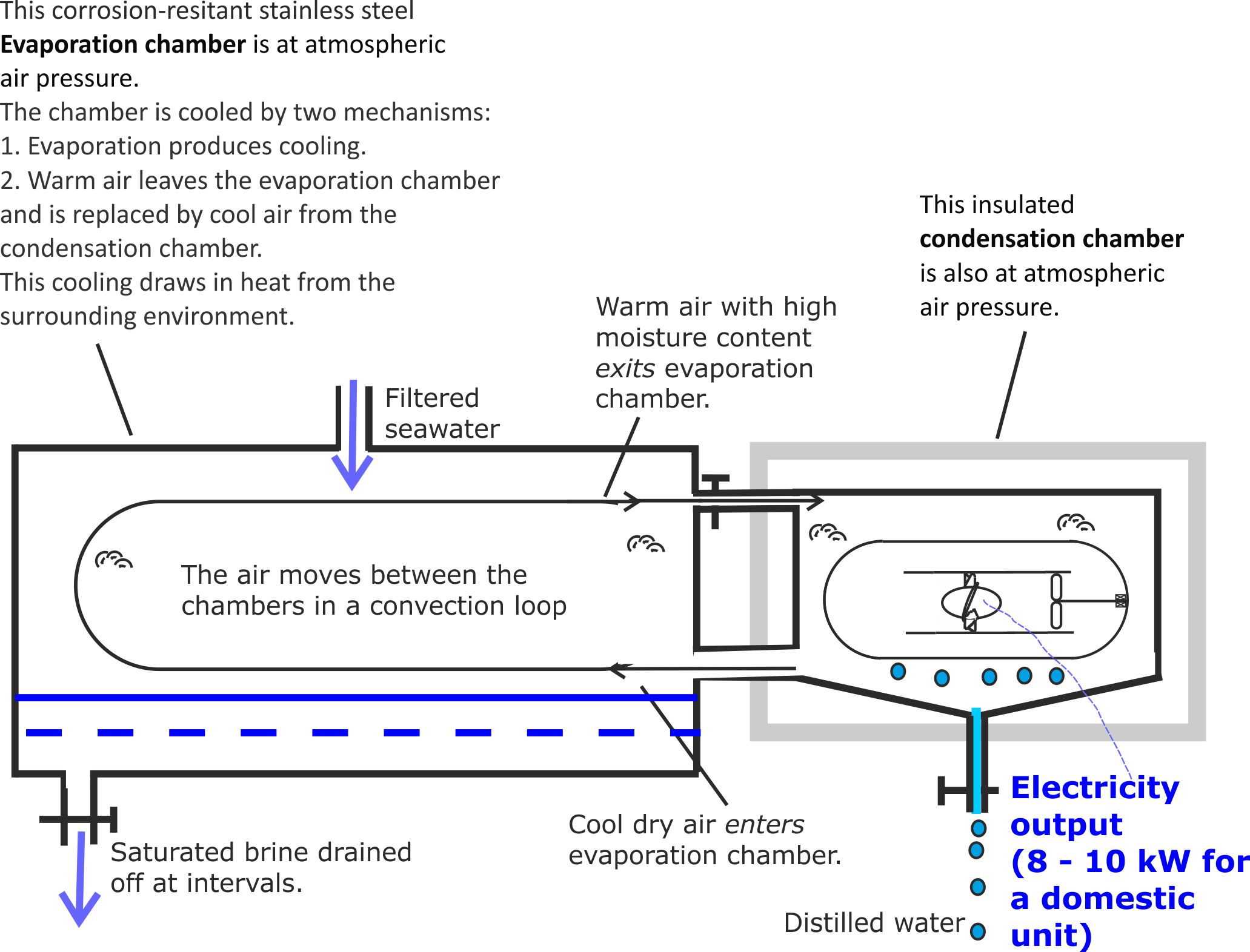
Figure 3. This system is primarily a power generator that produces fresh water as a bonus.
It could produce about 0.5 litre of distilled water per hour, for an environmental temperature of 20oC.
The system also produces an output of cooled air that can be used to cool a dwelling or storage space.
It is mechanically simple because it operates at atmospheric pressure. However, its distillation efficiency is low because a large fraction of the heat entering the evaporation chamber is used for warming air, rather than evaporating water.
Sea water corrosion is an issue, especially for the evaporation chamber. The two main solutions are to construct the chamber from glass fused steel or stainless steel.
Stainless steel has fifteen times the thermal conductivity of glass fused steel, allowing heat to flow in through all the chamber walls day and night. But it is also relatively expensive, with an evaporation chamber having 1 m2 upper and lower surfaces costing approximately £500.
A glass fused steel evaporation chamber with a glass or plastic lid could run on solar energy, on sunny days, producing up to 5 litres of water per day.
During the hours of darkness, a modest output of distilled water could be maintained, supplemented by the production of dew on the outer surface of the cover.
2.2 An improved water output design
If we pump the atmospheric air out of the system, all of the heat entering the evaporation chamber can be used to evaporate the brine.
By using atmospheric heat in this more efficient way, a 10 kilowatt LP Turbine will produce approximately 14 litres of water per hour, during the day and on warm) nights.
This output can be obtained, irrespective of atmospheric air temperature, provided that all parts of the system remain above the freezing point of water.
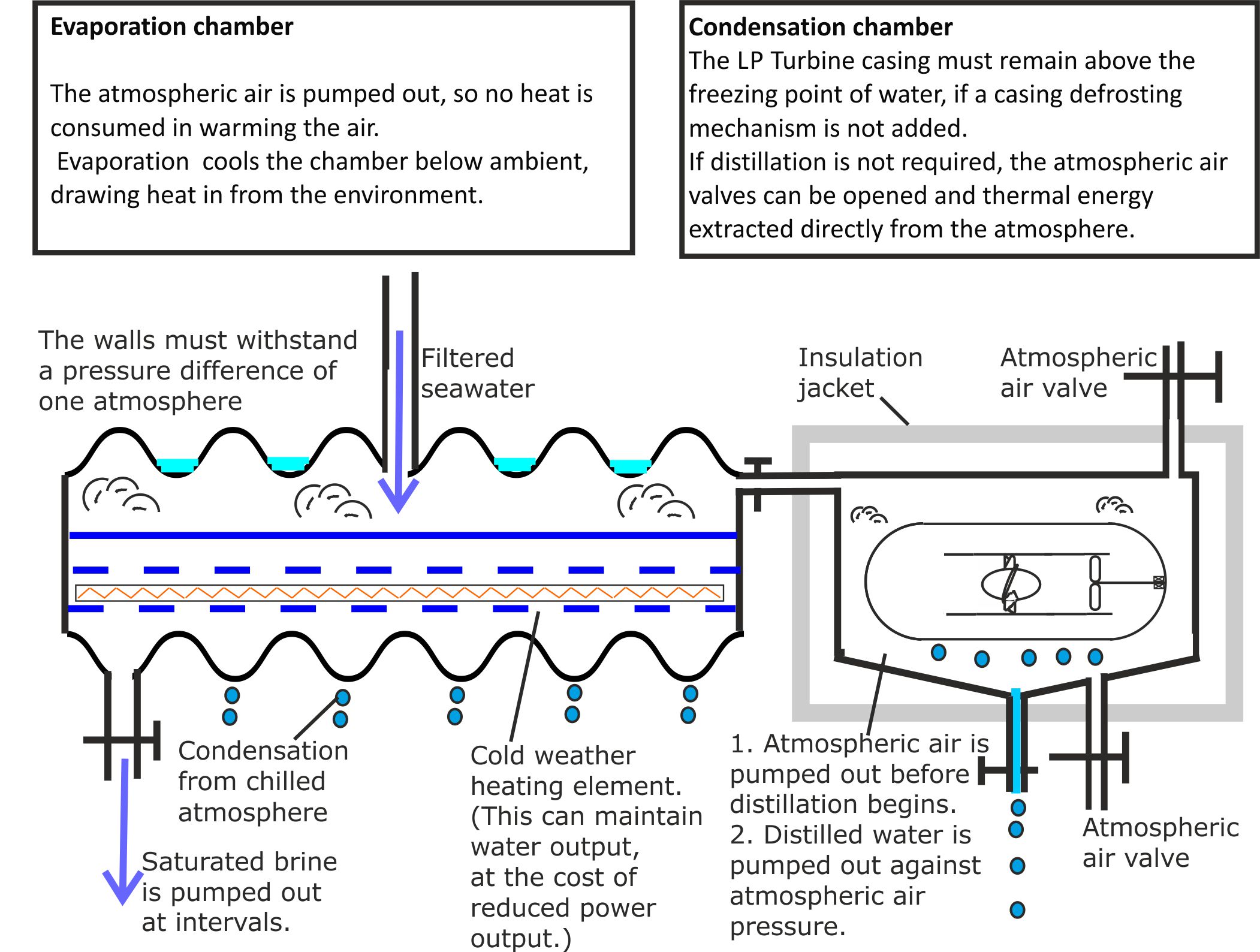
Figure 4 . The lines of ridges and furrows should tilt gently downhill to simplify dew collection.
2.3 A cascade system to multiply distilled water output
This design employs stainless steel partitions, wherever heat flows across the partition is desired, but saves on material costs by using glass fused steel elsewhere.
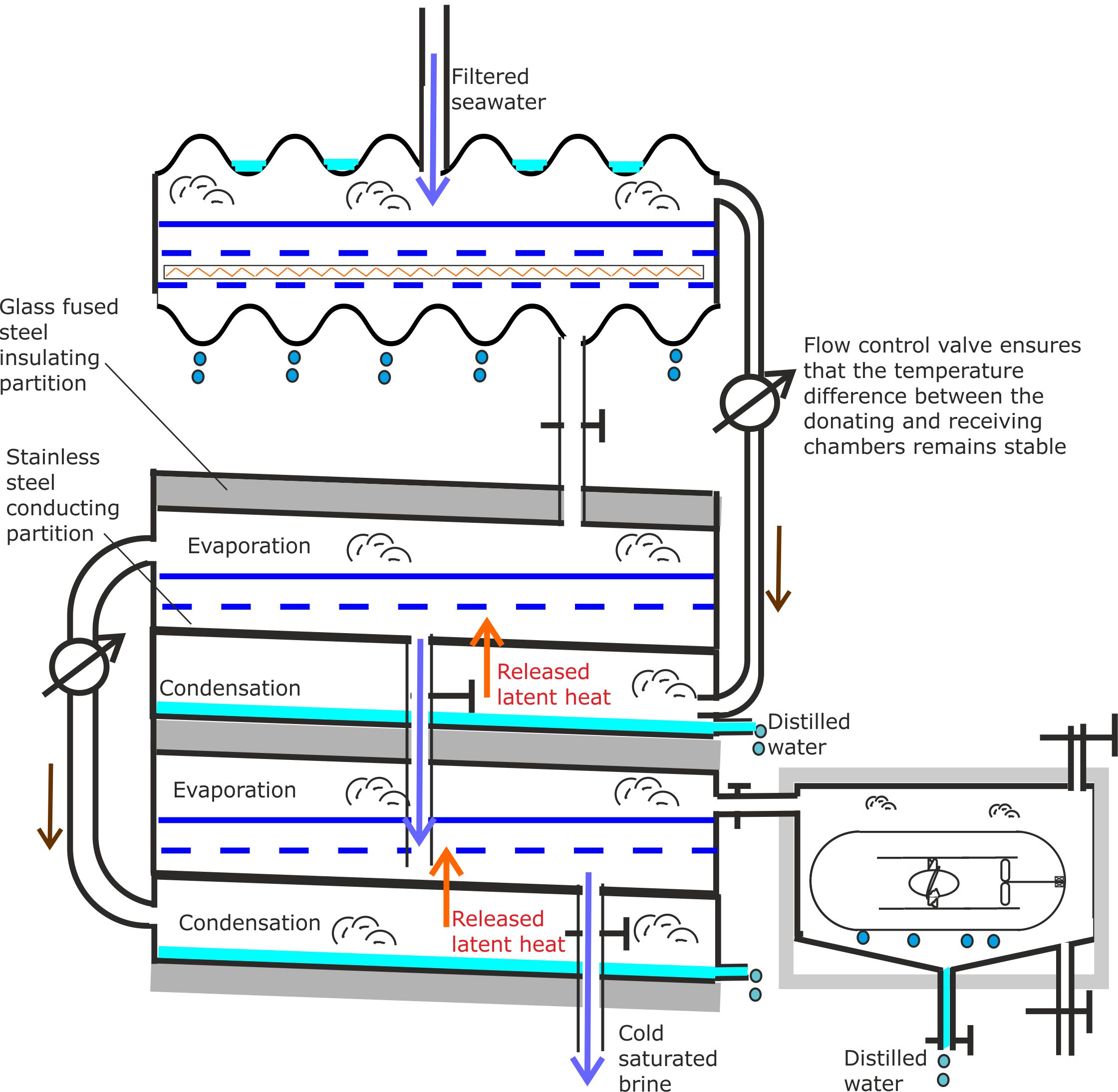
Figure 5. Several design variations on this concept are possible. These include
- Lagging the evaporation chambers and electrically heating the first stage in the cascade. A second LP Turbine will be required to prime the system and compensate for heat losses.
- The number of stages in the lagged cascade can be increased by raising the temperature in the first evaporation chamber. However, salt water corrosion increases exponentially with temperature. So, higher quality stainless steel may be required for the warmer chambers.
- Distillation systems should be relatively easy to maintain, but are far more bulky than their reverse osmosis equivalent. So for large scale desalination purposes, a reverse osmosis unit powered by an LP Turbine may be your best option.
3 Adding water harvesting and desalinating features to horticultural glasshouses
3.1 A water harvesting glasshouse
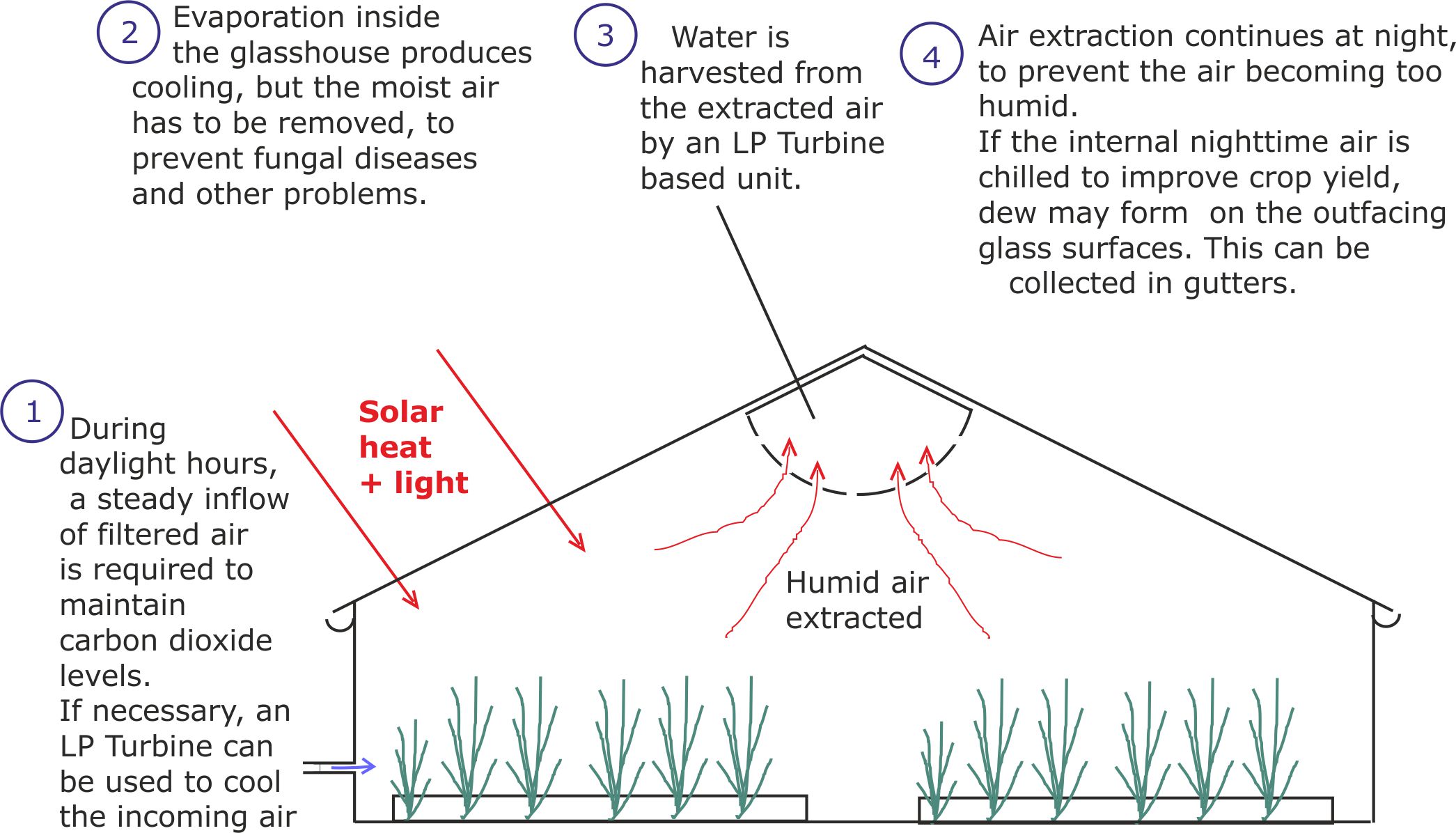
Figure 6.
During daylight hour, fresh air (filtered to remove insect pests) needs to be continuously fed into the glasshouse to maintain carbon dioxide levels.
During the night, the air still needs replacing at regular intervals, to keep the humidity low, and protect the crop from fungal diseases.
Many crops, such as leafy greens and tomatoes benefit from the air being chilled at night.
If LP Turbines chill the incoming air sufficiently, dew will form on the outer surface of the roof. This can be collected in gutters and used for irrigation.
3.2 A water desalinating glasshouse
This glasshouse could be self-sufficient in irrigation water and also produce a net output of electricity.
A novel feature of this glasshouse is that its roof takes the form of a cylindrical Fresnel lens that runs from North to South. The lens only needs to bring the solar radiation to a smeared out focus. So the lens can be constructed from (say) three types of glass roofing panel, each offering a different prismatic angle.
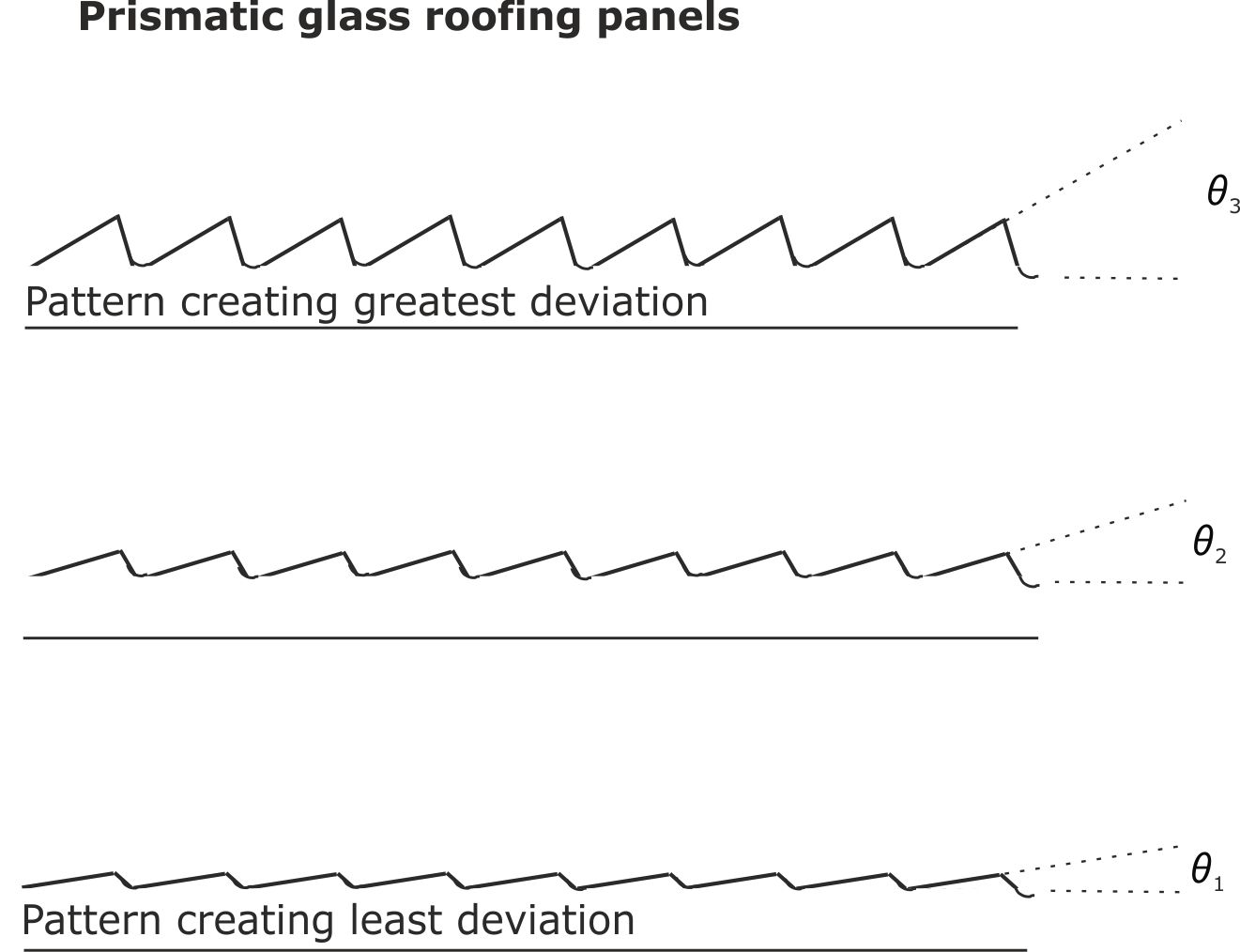
Figure 7. Patterned glass roofing panels will be more expensive to manufacture than flat glass. But the diffuse solar illumination that they produce will increase most crop yields. [Direct sunlight mainly benefits the top leaves, while diffuse solar radiation also benefits the lower leaves.]
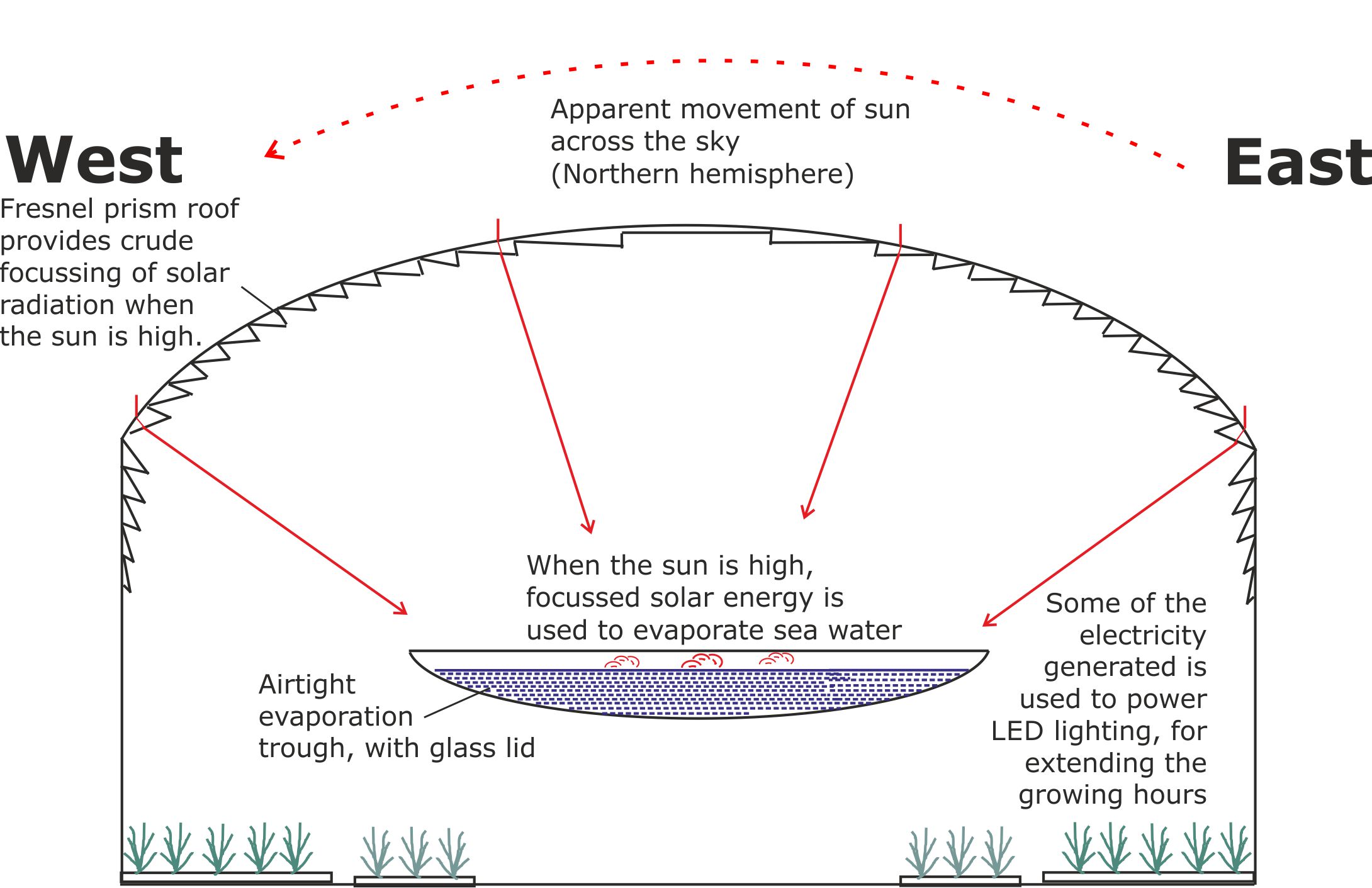
Figure 8. The solar radiation falling on the trough enables an LP Turbine to generate an equivalent amount of electricity.
Working conditions inside this glasshouse should be comfortable, even during a heat wave.
4 Exploiting polluted underground water resources
4.1 Repairing coastal freshwater aquifers
Salt water can leak into the aquifers if the local sea level rises or too much freshwater is drawn from them. This problem can be reversed if the aquifer is rested, but salt water just outside the freshwater zone is pumped out, encouraging freshwater to flow in and replace it. In warm climates, where LP Turbines rarely ice up, a simple PL Turbine with no electrical components could act as a mechanical work amplifier, for operating the pumps.
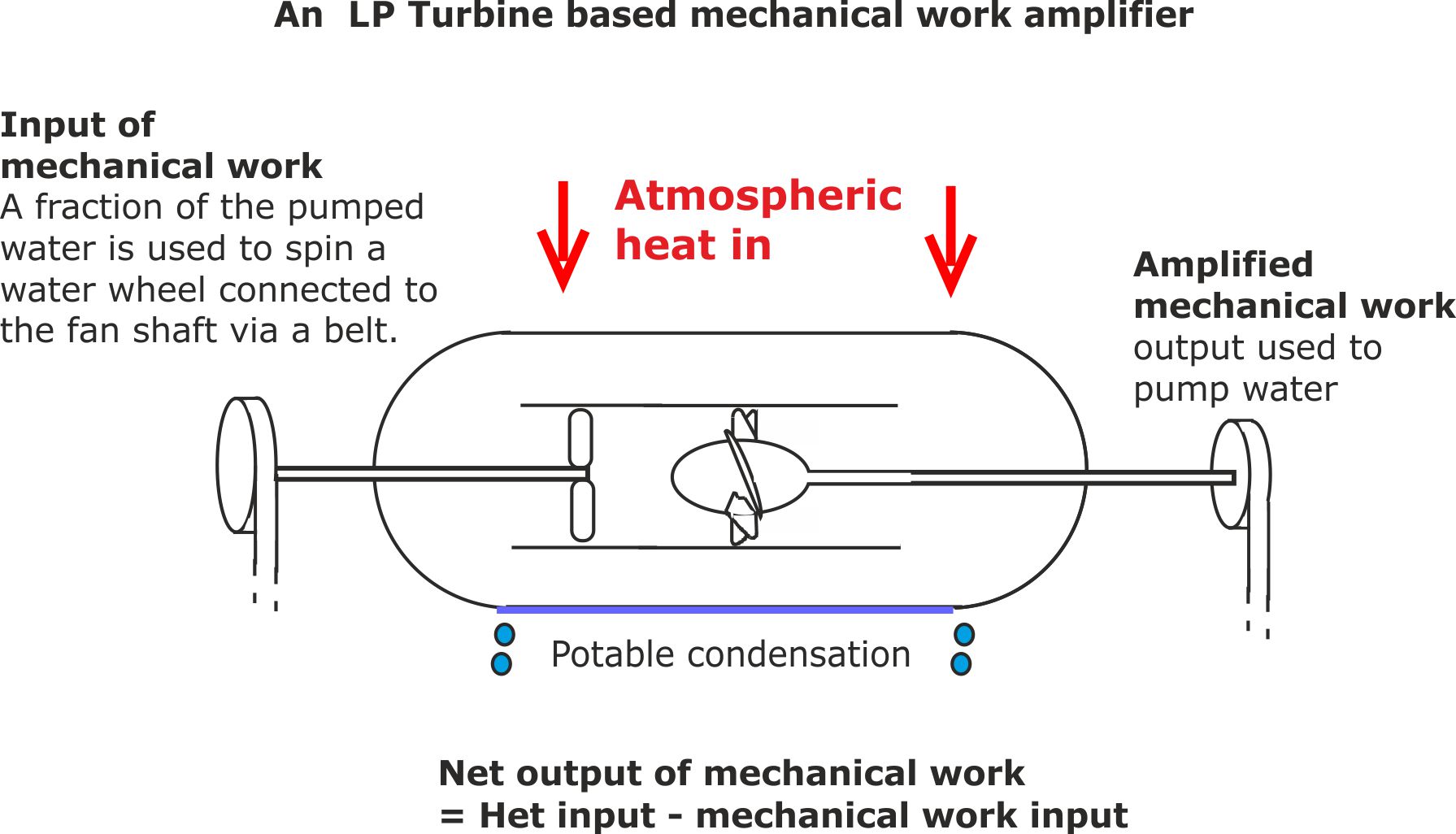
Fig ure 9. The brackish water that is pumped out of the aquifer could be partially desalinated so that the water fed back into the sea has the same salinity as the local sea water.
4.2 Using abandoned deep mine water for irrigation
This basic type of LP Turbine could also be used for pumping water out of abandoned deep coal mines.
Deep mine water can be as warm as 40oC, allowing an LP Turbine to run on thermal energy extracted from the water. Before being used for irrigation, the water would need to be aerated to solidify any dissolved iron and filtered, say by using cyclone filters, to remove the solid iron oxide particles. Both of these operations could be carried out using mechanical work provided by a basic LP Turbine.
Using deep mine water for crop irrigation is not a viable economic proposition today, mainly because of the cost of removing salt and other impurities. However, given the low cost of LP Turbine generated electricity and the increasing threat of prolonged draughts, this resource is worth investigating.