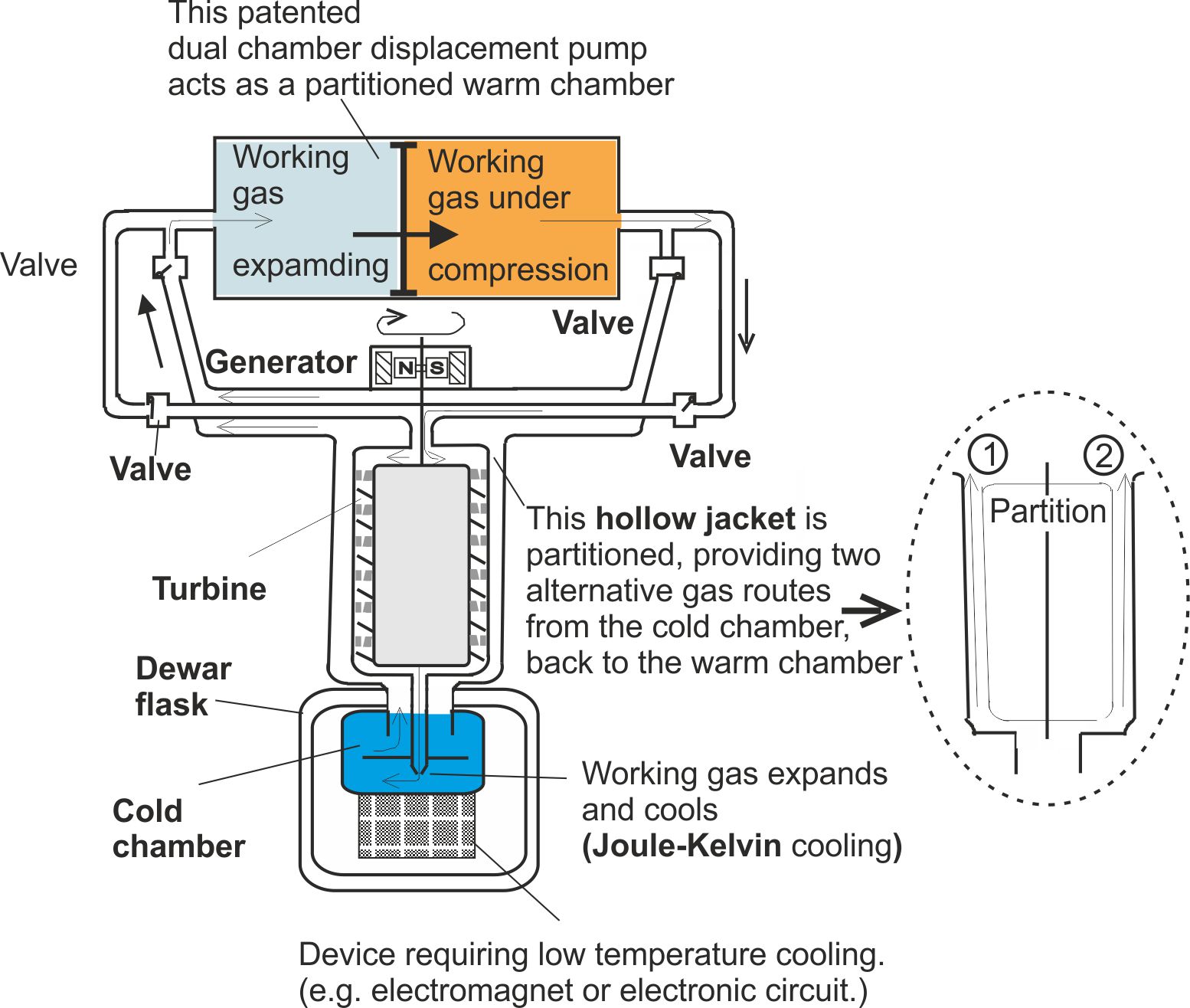
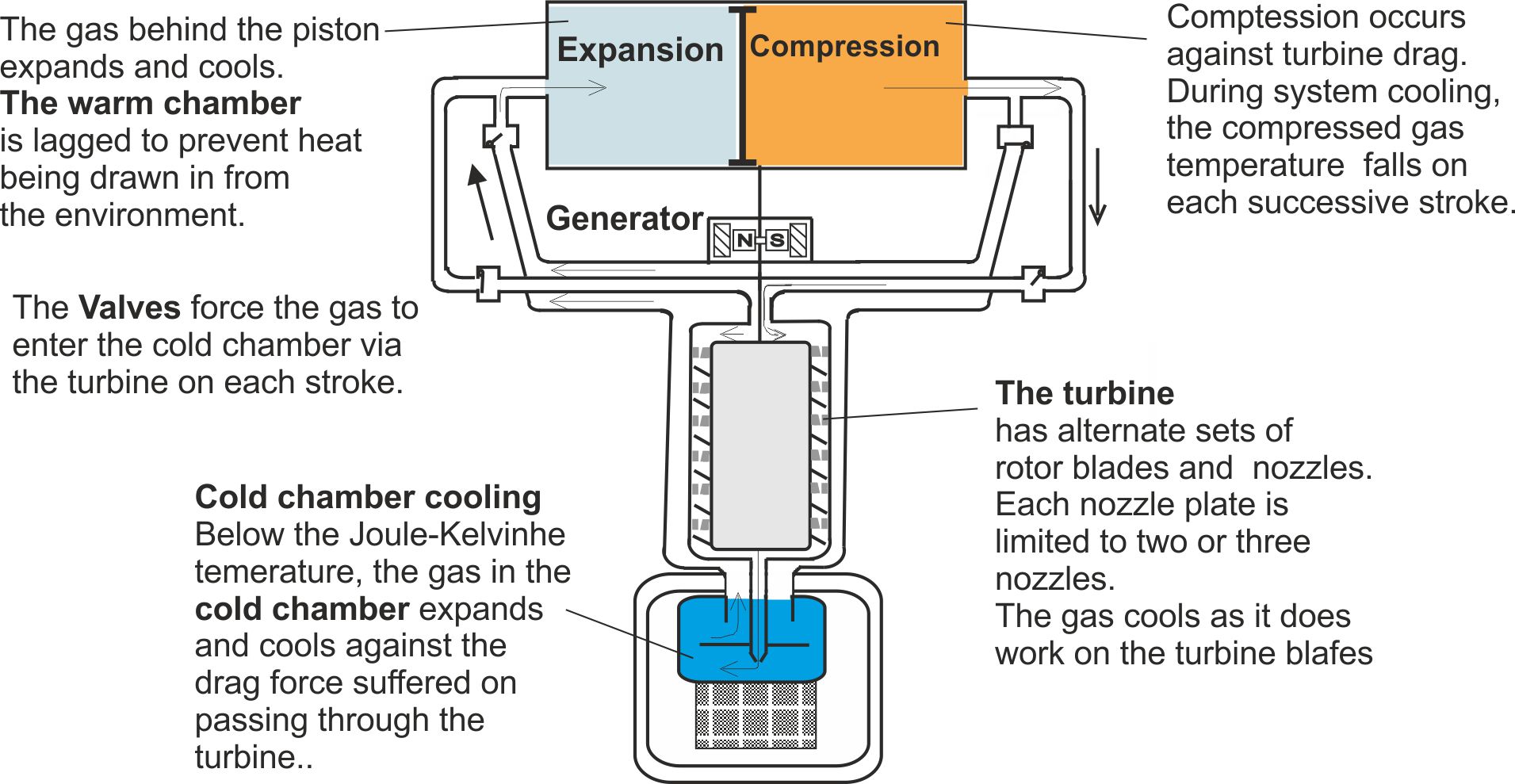
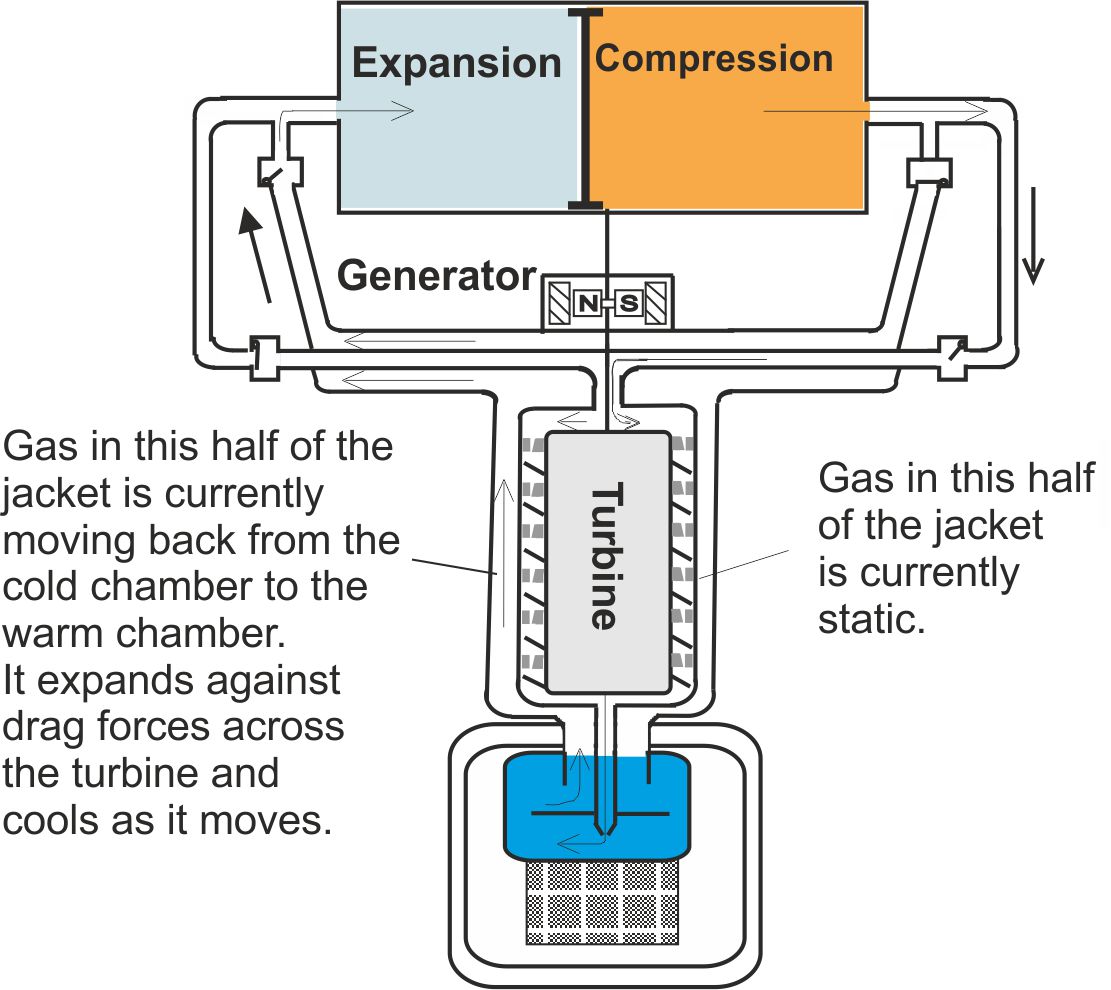
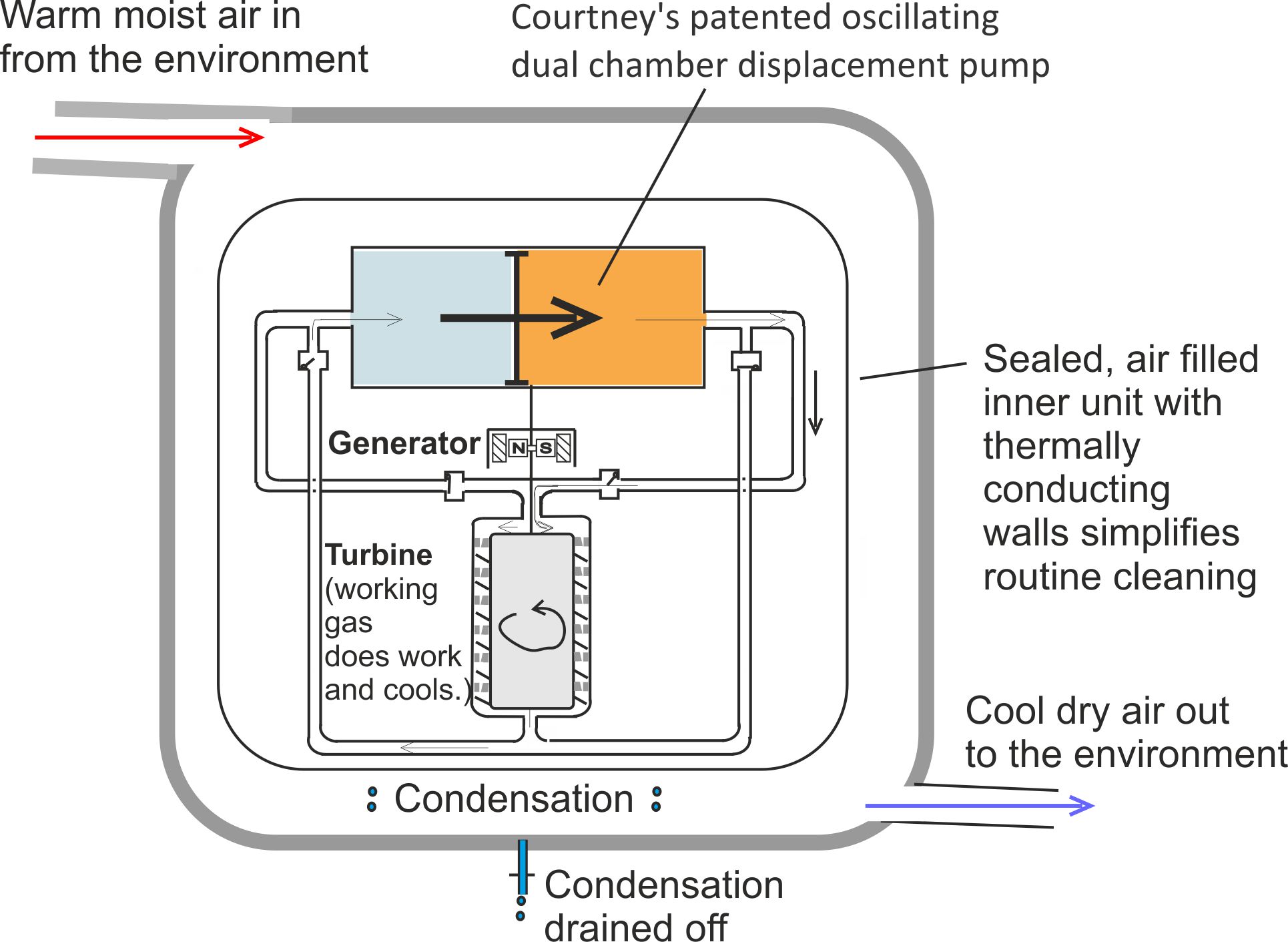
title graphic
 
Superconductors and cryocoolers

Patent application number GB 0907998.9

Article summary
Cryocoolers are low temperature refrigerators.  They are a key component in the development of superconducting power cables. Current designs are inefficient and expensive.
We propose a new design for a "Parallel Stirling refrigerator" that is thermally efficient and has no solid moving parts in the cold chamber.
The design could also be used in HFC (hydrofluorocarbon) free food refrigerators and air conditioning units.

Background
Efficient, moderately priced cryocoolers could be used in many ways, to improve the efficiency with which we transmit and utilise electricity. Superconducting power cables, operating at very low temperatures would eliminate power transmission line cable losses. They would also make it cost effective to bury the transmission cables underground, instead of having to rely on overhead transmission lines. Superconducting cables could be used for transmitting power from remote tidal barriers and  solar  powered generators in desert regions, to the big cities.

Superconducting magnets would reduce heat losses in electric motors and generators. They would also reduce the running costs of magnetic traction rail transport systems.

Cryocoolers based on Stirling engines working in reverse have used for may years. The snags with existing designs include short working life and low efficiency. 

Basic principles: the current "series" Stirling refrigerator design

Fig. 1. The basic features of a Stirling refrigerator.

Stirling refrigerators include warm and cold chamber pumps. These are used for pumping a gas, typically helium, between the chambers.
The pistons move in a series of synchronised steps to cause heating in the warm chamber and cooling in the cold chamber.

The ideal series of steps is as follows:

Fig. 2(i) The warm chamber piston moves part way to right, while the cold chamber piston blocks the mouth of the cold chamber. This compresses the working gas in the warm chamber. Ideally, all of the heat of compression is dissipated into the environment.
 

Fig. 2(ii) Both pistons move to the right so that pressurised gas is displaced into the cold chamber at approximately constant pressure.
 

Fig. 2(iii) The cold chamber piston moves further to the right so that the gas expands and cools.


Fig. 2(iv) Both pistons move to the left, so that the gas moves back into the warm chamber at low pressure. The first stage is then repeated.

In reality it’s not possible to stop and start the pistons when they are operating at a useful frequency. Instead the cycle is approximated by oscillating the pistons sinusoid ally, but 90o out of phase. This reduces efficiency because the compression and expansion phases partly overlap.

An even bigger problem is the wear and tear caused by operating a piston in the harsh environment of the cold chamber.

Engineers have developed variations on the Stirling concept that eliminate the need for a piston in the cold chamber but at the price of a further drop in efficiency caused by even larger deviations from the ideal stop-start Stirling cycle.


The Parallel Stirling design

We argue that the limitations of the current Stirling refrigerator design can be overcome by employing a Parallel Stirling system, where compression in the warm chamber occurs simultaneously with expansion in the cold chamber.
Two core ideas essential to the Parallel Stirling design are:

(i) Replace the standard warm chamber pump with a dual chamber pump that simultaneously pushes and pulls the gas through the cold chamber.
 

Fig. 3. A dual chamber pump.


(ii) Force the gas to do external work before it enters the cold chamber.


(i) The dual warm chamber pump

Fig. 4. A dual warm chamber pump can simultaneously move gas in and out of the cold chamber. But, the gas pressure remains approximately uniform throughout the system, so by itself, it cannot produce cooling.

(ii) Forcing the gas to do external work before it enters the cold chamber

Fig. 5. By adding an obstruction the gas in the cold chamber is forced to expand when the piston moves to the right.
We could partially block the pipe to create an obstruction, but this would pointlessly generate waste heat. A better solution would be to force the gas to do useful work.

Making the gas do useful work

Fig. 6. The obstruction takes the form of an external work unit which generates electricity. This can be fed back into the system to offset some of the energy used to drive the warm chamber pump.


The basic Parallel Stirling design

In order to move towards a practical design, symmetry needs to be built into the system so that expansion occurs in the cold chamber on both strokes of the warm chamber piston.
Parts of the system will also need lagging. To avoid visual clutter, lagging has been omitted from the diagrams.

Fig. 7. Both strokes of the piston produce cooling. This speeds up the rate of cooling compared with serial Stirling refrigerators.
As the cold chamber gradually cools, the gas density in the cold chamber increases. Consequently, the gas pressure in the system falls after each stroke.

Unlike series Stirling refrigerators, the design includes valves in the room temperature part of the system. This is a small price to pay for the removal of solid moving parts from the cold chamber.
The Parallel Stirling design also includes work units which generate electricity synchronised to the movement of the warm chamber piston. This can be fed back into the system, increasing efficiency and reducing running costs.

Fig. 8. The output of electricity from the work units is synchronised with the movement of the warm chamber piston, allowing the electricity to be fed back into the pump motors.


Further improvements to heat pumping efficiency

The basic Parallel design has limited heat pumping efficiency because the gas is cooler than strictly necessary in two parts of the system.

Fig. 9.

(i)                 The warm chamber is simultaneously warmed and cooled, so it's less effective than the series Stirling design for dissipating heat into the environment.

(ii)               If the warm chamber dissipates significant heat into the environment, the gas will leave the work units at a temperature below ambient. Consequently gas exiting the heat exchanger, on its way back to the warm chamber will also be below ambient temperature. This also reduces efficiency by partially cooling the warm chamber.

(i) Preventing expansion in the warm chamber

Jet pumps can be used to draw gas out of the cold chamber and deliver it to the warm chamber at approximately constant pressure.

                                     Fig. 10. The jet pump principle.


Fig. 11. Adding two jet pumps restricts gas expansion to the cold chamber. This completes the analogy with the traditional Stirling refrigerator, because gas is displaced into the warm chamber, instead of expanding into it.
 

There are two features worth noting: (a) The jet pumping rate varies automatically in harmony with the warm chamber pumping rate because they share a common source of compressed gas. (b) The ideal stop-start motion of the pistons in the traditional Stirling design is redundant because compression and expansion are automatically synchronised.

(ii) Preventing the entry of cool gas into the warm chamber

Fig. 12. This is a close-up view of the region where compressed gas enters a work unit.
Gravity fed heat pumps extract heat from warm gas leaving the warm chamber and transfer it to cool gas entering the chamber. This creates a positive feedback loop:
Gas entering the work unit is cooled
 -> Gas leaves the work unit at a lower temperature
-> Gas enters the heat pump at a lower temperature
 -> Ability to absorb heat from the pump increases.

For aerospace applications, the gravity feed can be replaced with a wick.

Summing up the new design
Traditional and Parallel Stirling cryocoolers share three common processes; compression, expansion and displacement at approximately uniform pressure into the warm chamber.
These events can only take place simultaneously because:
a) A dual warm chamber pump is used.
b) The gas is forced to do external work before it enters the cold chamber.

Fig. 13.  The new fridge offers two cooling processes: Traditional Stirling expansion plus cooling as a consequence of generating electricity.

The Parallel Stirling cryocooler includes a number of innovative features. Experiments will be necessary to determine the optimum design required for a specific application. For example the Dewar flask in Figure 13 can be extended to enclose the external work units and a single heat exchanger can be used to cool the gas emerging from the warm chamber. This design is illustrated below.

Fig. 14.  Design incorporating a larger Dewar flask and a single heat exchanger for all couplings entering or leaving the Dewar.

Examples of lubricant free dual chamber pumps

(i) A simple pump based on existing loudspeaker designs

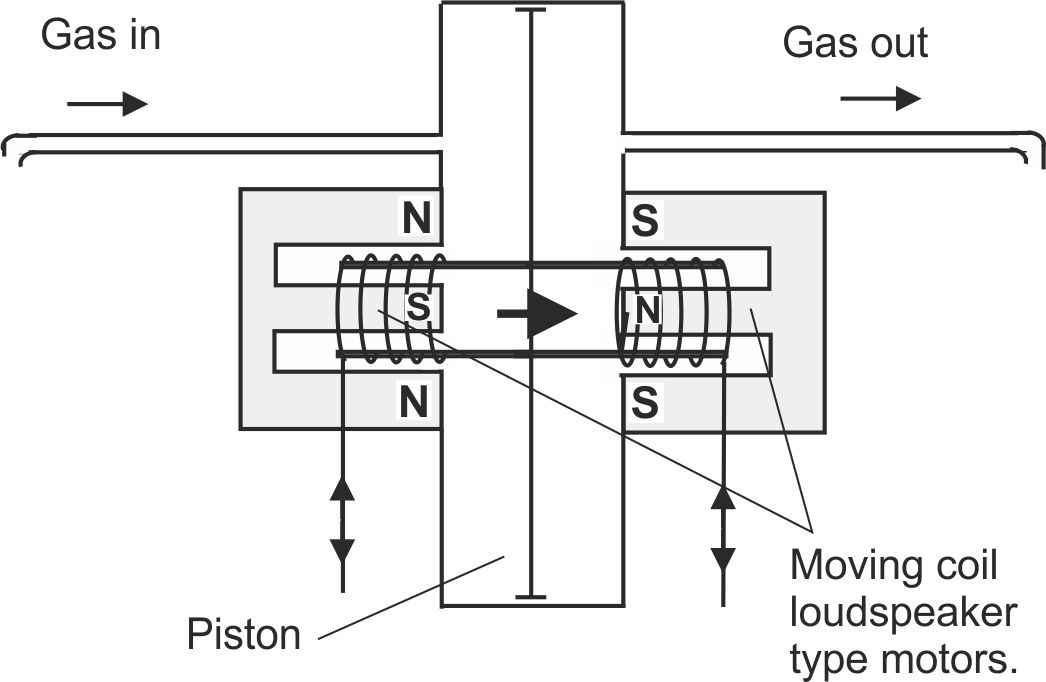
Fig. 15. An oscillating diaphragm partitions the warm chamber. Two motors drive the diaphragm, these being essentially powerful moving coil loudspeaker type motors. Armature coils mounted centrally, one on each side of the diaphragm carry alternating currents. These act in harmony, causing the diaphragm to oscillate to and fro, between two pot shaped permanent magnets.

(iii) If larger volume and pressure changes are needed, two piston and cylinder pumps, driven by a simple "solenoid and plunger" linear motor can be used.

Fig. 16. The two pistons pump in anti-phase and are motivated by a simple linear motor. Each of the solenoids, A and B can be replaced by a pair of solenoids, as in Figure 8.

(ii) For novel dual chamber pump designs offering high pumping displacements, please visit our Lubricant free pump page.

Examples of lubricant free work units

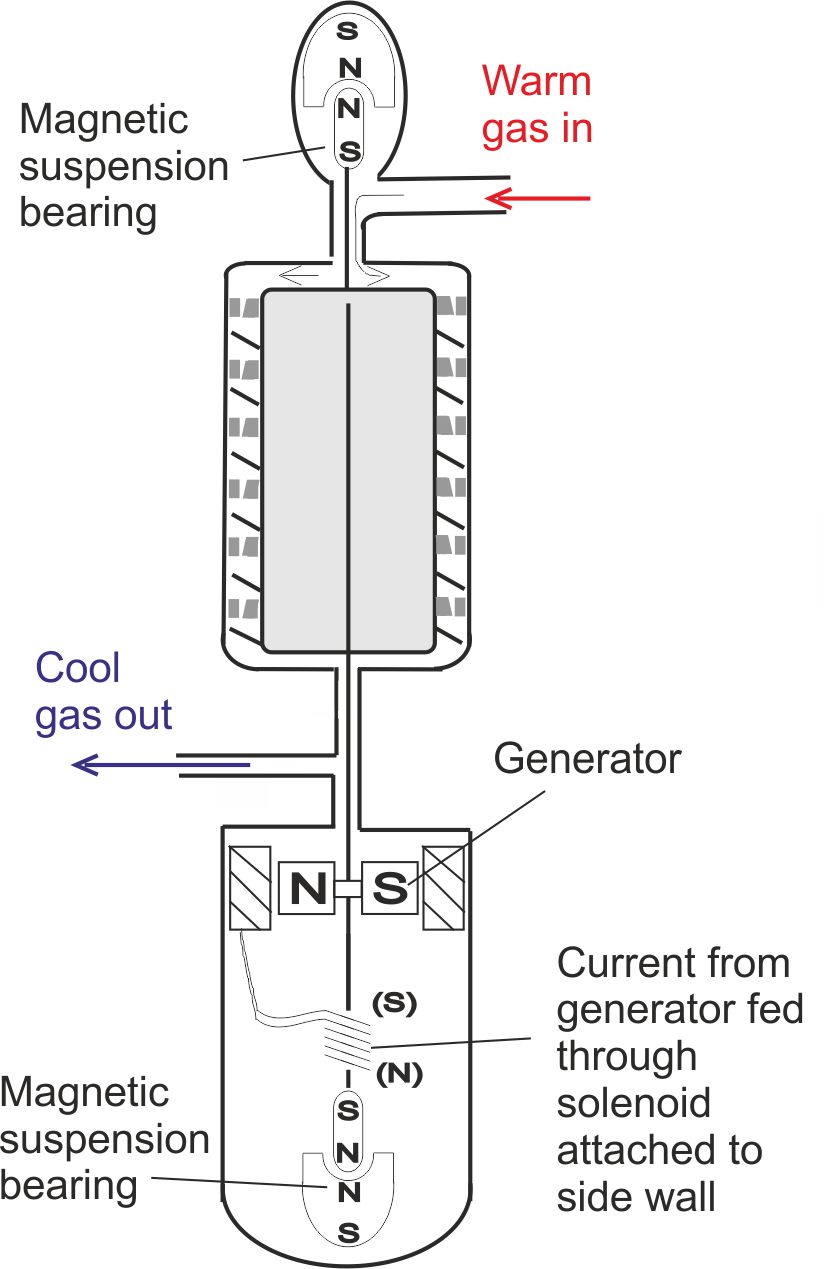
Fig. 17. This work unit is a turbo-generator mounted on magnetic repulsion bearings.
The coil draws its current from the adjacent turbo-generator, so the coil’s magnetic attraction for the underlying bar magnet varies in step with the rate at which gas is pumped through the turbine.

Fig. 18. This work unit consists of a bank of flexible piezo-electric baffles. These produce a transient potential difference across their opposite faces, when temporarily deformed.


Key benefits of the Parallel Stirling cryocooler design

1. Existing Stirling refrigerators are inherently inefficient because their sinusoidal movement is only a crude approximation to the jerky stop-start movement demanded by ideal Stirling theory. The parallel design theory does not require stop-start movements.

2. The parallel design further improves efficiency by generating electricity as a by-product of the cooling process.

3. There are no solid moving parts in the cold chamber. Consequently, cold chamber abrasion and swarf accumulation problems are eliminated.

4.  Linear motors are employed in the warm chamber, so piston side slap wear is eliminated.

5. Any  gas leakage across the warm chamber piston/diaphragm stays within the warm chamber housing, so there will be reduced loss in  performance due to aging.

6. The solution of traditional wear and leakage problems will allow the refrigerator to be welded closed in order to prevent leakage of the working gas. (Helium is notorious for its ability to escape through seals in refrigeration systems.)

7.      The absence of moving parts in the cold chamber helps to optimise cold chamber design. For example,
(i) heat exchange honeycombs or loose matrix material can be added, to enhance heat transfer between the working gas and the items which need to be cooled, (ii) the cold chamber can be constructed from a wider range of materials.

8. The simplified cold chamber design will reduce acoustic and electromagnetic vibration problems if delicate sensors are mounted in the cold chamber.

9. The cold chamber can be moulded to fit snugly around an electromagnet, circuit or sensor. The engineer also benefits from a similar flexibility in deciding on the Dewar flask shape.

10. The cold chamber has a minimum of connections to the warmer parts of the system, so heat leakage into the cold chamber is also minimal.

11.     At maximum power, the dual chamber design allows the total volume of the warm chamber to be used This offers a good power to size ratio compared with existing cryocoolers,

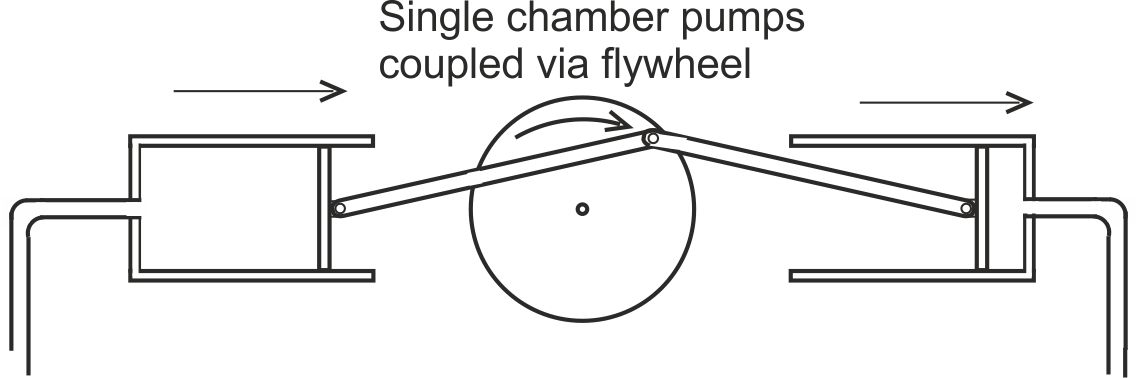
12. The use of linear motors eliminates energy losses due to the swirling of gases inside rotating flywheel crank case.

13. It also allows  power output to be varied by varying the motor runner displacement. Its operating frequency can be held constant at a preferred resonance frequency, in tune with other components such as piezo-electric work units, but filtered out by local signal sensitive detectors.

14.   The parallel design is more complex because valves and external work units are required, but the use o magnetic bearings means that lubricants are eliminated and  fewer precision engineered components are required.

15.    If the gas transfer lines connected to the cold chamber are flexible, the design provides a low inertia sensor cooling unit, suitable for rapid movement scanner systems.

16.The higher levels of thermal efficiency simplify heat dissipation problems in space applications.


The proof of concept model

The inventor, Bill Courtney,  is looking for partners to build a proof-of-concept Parallel Stirling refrigerator. If you would like to take up this challenge, here is a basic refrigerator design which does not involve any novel components.

Fig. 19. The function of the obstacles is to create conditions for pressure drops inside the cold chamber as gas is drawn out behind the currently advancing piston.
Heat is generated inside the obstacles as work is done against viscous drag.
Standard design features can be incorporated to enhance the rate of heat dissipation from the obstacle surfaces. e.g., adding cooling fins, painting surfaces matt black placing the apparatus in a draught etc,.
 

It is important to emphasise that these obstacles are not Joule-Thomson plugs.
This design would be needlessly inefficient for practical purposes because we can do useful inside the obstacles instead of generating waste heat.

These cryocooler designs are protected by a patent application and copyright. Please contact Bill Courtney before embarking on any experimental work that you intend to publish.

MagTrac: For a suggested transport application of the Parallel Stirling Cryocooler please visit out Transport Internet page.